

On July 16, 2026, Moonshot AI released Kimi K3, a 2.8-trillion-parameter mixture-of-experts model (MoE) that the company describes as the world’s first open “3T-class” system (Moonshot AI launch blog; VentureBeat). Within days, Kimi K3 took the top spot on the Frontend Code Arena leaderboard at 1,679 Elo, ahead of Claude Fable 5 (Arena.ai). It posted a 93.5% score on GPQA-Diamond, an 88.3% score on Terminal-Bench 2.1, and a 91.2% score on BrowseComp — the strongest published results on those benchmarks for any open-weight model at the time of release (Moonshot AI launch blog, independently verified by multiple trackers).
By any conventional measure, this is a frontier-class model, and it is one that anyone can, in principle, download and run. But “in principle” is doing a great deal of work in that sentence. Moonshot’s own deployment guidance recommends serving Kimi K3 on a supernode configuration with at least 64 accelerators (Northflank; k3nova). The full weights, in BF16, occupy roughly 594 GB — larger than the usable HBM3e capacity of a single NVIDIA DGX B200 system. Third-party analysis puts the realistic production floor at eight H100 80GB GPUs, and even that configuration is described as a minimum, not a comfortable operating point.
On July 27, 2026, Moonshot published the full weights on Hugging Face, making them freely available for download, modification, and self-hosting under a custom “Kimi K3 License.” The license permits unrestricted use for most purposes, but imposes commercial conditions: organizations operating a “Model as a Service” business with aggregate affiliate revenue exceeding $20 million over any 12-month period must enter a separate agreement with Moonshot AI; and products or services with more than 100 million monthly active users or $20 million in monthly revenue must prominently display “Kimi K3” in their user interface. Internal use and use through Moonshot’s official API or certified partners are exempt from these requirements.
What is more consequential for infrastructure planning, however, is the hardware floor: a model whose weights alone exceed the memory of any single accelerator server on the market, and whose recommended production configuration puts it firmly in hyperscaler and national-lab territory.
The question this raises for infrastructure engineers and technical decision-makers is not “is Kimi K3 capable?” — the benchmark record answers that reasonably well. The question is what “open weight” actually buys an organization when the computational floor required to use those weights productively is itself a form of gatekeeping.
This article works through Kimi K3’s architecture, its published capability profile, the hardware configurations required to serve it, the total cost of ownership (TCO) across cloud and capital paths, and what the model’s own weakest benchmark category — agentic performance — implies for teams evaluating it as a substrate for production AI agents.
The Kimi K3 Capability Ceiling
Architecture & Specifications Summary
Kimi K3 is a sparse mixture-of-experts (MoE) model with 2.8 trillion total parameters, of which only 16 of 896 experts activate per token — approximately 1.8% of the total parameter pool. This sparsity is what makes a model of this scale computationally tractable at all: the active parameter count per forward pass is a small fraction of the headline figure, which keeps per-token compute costs down even though the storage footprint remains enormous.
The model supports a 1-million-token context window and introduces two architectural changes relative to its predecessor, K2.6:
- Kimi Delta Attention (KDA) — a hybrid linear-attention mechanism that interleaves cheap linear-attention layers with periodic full-attention layers, reportedly in roughly a 3:1 ratio (MoonshotAI/Kimi-Linear GitHub repository). According to Moonshot’s own research published on arXiv, this design reduces memory and KV-cache usage by up to 75% and delivers markedly faster decoding at long context lengths, without sacrificing quality on short-context tasks (Kimi Team, “Kimi Linear: An Expressive, Efficient Attention Architecture,” arXiv:2510.26692, 2025).
- Attention Residuals (AttnRes) — described by Moonshot as a drop-in replacement for standard residual connections intended to improve information flow between layers during training and inference.
On the numerical-precision side, Kimi K3 uses MXFP4 weights with quantization-aware training applied from the supervised fine-tuning stage onward (Wan 2.7 VRAM analysis; k3nova hardware guide). This matters operationally: because the model was trained with this quantization scheme in mind rather than quantized after the fact, a 4-bit deployment is closer to the training-time precision than a typical post-hoc quantization would be, which should reduce (though not eliminate) the usual accuracy loss associated with aggressive quantization.
To understand the deployment demands of Kimi K3, it helps to first look at its underlying technical design. The table below summarizes the model’s core architectural specs and their practical engineering trade-offs.
| Feature / Metric | Specification | Engineering Significance |
|---|---|---|
| Total Parameter Scale | 2.8 Trillion | Sparse MoE architecture; largest open-weight model at release. |
| Active Parameters | 16 / 896 Experts (~1.8% / ~50B equiv.) | Keeps per-token compute low despite huge total footprint. |
| Context Window | 1,000,000 tokens | Enabled by Kimi Delta Attention (KDA). |
| Quantization Scheme | MXFP4 Weights | Quantization-aware training (QAT) minimizes accuracy loss. |
| BF16 Weight Size | ~594 GB | Operational footprint required at load time for standard inference. |
Benchmark record
The published benchmark table, drawn primarily from Moonshot’s own launch materials and cross-referenced against independent trackers, includes:
- Frontend Code Arena: 1 ranking, 1,679 Elo, ahead of Claude Fable 5’s 1,631 (Arena.ai).
- Terminal-Bench 2.1: 88.3% (Moonshot’s own KimiCode harness); an independent Artificial Analysis evaluation using a different harness put the figure closer to 85% (Artificial Analysis, cited via emergent.sh).
- BrowseComp: 91.2% with context compaction triggered at 300K tokens; 90.4% on the full 1M-token window without compaction — still the leading published score at release (BenchLM.ai; Wan 2.7).
- GPQA-Diamond: 93.5%, described by multiple trackers as the strongest open-weight result published on this benchmark at the time (Labellerr; Wan 2.7).
- Humanity’s Last Exam, with tools: 56.0%; without tools, a considerably weaker 43.5%.
- MMMU-Pro: 81.6%
- Artificial Analysis Intelligence Index: 57.11, placing Kimi K3 fourth overall among 189 tracked models — behind Claude Fable 5 (59.86) and two GPT-5.6 Sol configurations, but ahead of Claude Opus 4.8 (55.69), Grok 4.5, and GLM-5.2 (Artificial Analysis, via augmentedmind.substack.com and bleap.finance).
- BenchLM overall leaderboard: #5 of 215 models tracked, with a composite score of 79.98; on BenchLM’s stricter verified leaderboard, #4 of 101 (BenchLM.ai).
Two figures inside this record deserve particular attention, because they run against the intuitive assumption that a larger model performs uniformly better across all task categories. On BenchLM’s category breakdowns, Kimi K3 ranks #6 of 129 tracked models on agentic tool-use and computer-operation benchmarks, with an average score of 66.5 — its weakest showing of any category BenchLM tracks. On multimodal and grounded-task benchmarks, by contrast, Kimi K3 ranks #2 of 32 models, with an average score of 89.6 — its strongest category by a wide margin.
This is a meaningful signal for infrastructure teams evaluating Kimi K3 for a specific workload rather than a general capability score. A model can occupy the near-frontier on aggregate metrics while still trailing meaningfully in the specific category — sustained, multi-step, tool-mediated task execution — that most production agent deployments actually depend on. Raw parameter count and MoE sparsity clearly buy Kimi K3 strong coding and multimodal performance; they do not, on the evidence so far, automatically confer the reliability characteristics that agentic workloads require. The Agentic Angle returns to this point in more depth.
“A model can occupy the near-frontier on aggregate metrics while still trailing meaningfully in the specific category — sustained, multi-step, tool-mediated task execution — that most production agent deployments actually depend on.”
It’s also worth noting an asterisk that several independent reviewers have flagged: most of the headline figures above are Moonshot’s own reporting, generated under a “max” reasoning-effort setting, and independent verification was still catching up as of the days immediately following launch (buildfastwithai.com; kingy.ai).
Where Artificial Analysis has run its own harness — Terminal-Bench 2.1 being the clearest example — the independently measured score has come in a few points below Moonshot’s self-reported figure. None of this changes Kimi K3’s overall competitive position, but it is a reasonable prior for any team incorporating these numbers into a procurement decision: treat vendor-reported benchmarks as a strong early signal, not a settled verdict, until broader third-party coverage accumulates.
The Kimi K3 Infrastructure Floor
Moonshot’s own guidance
Moonshot’s official production deployment recommendation is a supernode configuration with 64 or more accelerators. Notably, the company has not published a validated minimum-viable GPU count for production serving — the 64-accelerator figure is a recommendation for competitive throughput at scale, not a documented lower bound.
Third-party minimum configurations
In the absence of an official minimum, the most detailed public VRAM analysis comes from the Wan 2.7 Kimi K3 guide, which derived its figures from direct deployment testing on H100 clusters running vLLM with Kimi K3’s KDA attention — measured at real out-of-memory boundaries rather than theoretical calculations. The consensus picture from that analysis:
- Experimental / non-production: 4× H100 80GB, providing 320 GB of aggregate VRAM. This is enough to load a reduced-precision version of the model (Q2–Q4) with a shortened context window of up to 64K tokens and slower generation. Wan 2.7 explicitly flags this tier as the absolute minimum to run the model at all, not as a viable production configuration.
- Production minimum: 8× H100 80GB, providing 640 GB of aggregate VRAM — just enough to load the full 594 GB BF16 weight set with headroom for KV cache, at up to roughly 512K context. With H200 GPUs (141 GB each), the same eight-card count provides 1.1 TB, giving comfortable headroom for the full 1M-token context window.
- BF16 weight size: approximately 594 GB, the figure used consistently across independent VRAM analyses.
- Quantized weight sizes: The Kimi K3 model was trained with MXFP4 quantization-aware training, and the released weights are stored in a compressed format derived from that training. At load time, however, they unpack to a ~594 GB BF16 inference resident set — the precision the weights occupy in GPU memory during actual matrix operations. Wan 2.7 treats this BF16 figure as the operational baseline for VRAM planning. Quantized deployments (Q4, Q3, Q2) keep weights in lower precision during inference, reducing the resident set to roughly 325 GB, 275 GB, and 225 GB respectively — making them smaller, not larger, than the BF16 footprint.
These third-party minimums address a specific question: can the model load into VRAM and generate a single sequence? The 8×H100 “production minimum” fits the BF16 weights and one sequence at up to ~512K context, but with only ~20 GB of aggregate headroom it has no margin for batching, multi-tenant concurrency, or the full 1M-token window. Moonshot’s 64-accelerator recommendation, by contrast, targets competitive throughput at scale — the point where tensor-parallel overhead across multiple nodes, batching headroom, and the full context window all become simultaneously achievable.
“The 8-GPU figure is a single-stream production floor; the 64-GPU figure is a multi-tenant production target.”
Why 594 GB is the load-bearing number
This figure matters because it exceeds the usable high-bandwidth memory of the most capable single-node inference system commercially available in the H100 generation. An 8×H100 cluster with 640 GB of total VRAM has as little as 20 GB of headroom once weights, KV cache, and overhead are all accounted for — a margin that leaves essentially no room for error in configuration or unexpected memory growth.
NVIDIA’s newer DGX B200 system provides roughly 1.44 TB of total HBM3e across its eight B200 GPUs — enough in raw terms to hold K3’s BF16 weights with substantial headroom, but once KV cache at the full 1M-token context, activation buffers, and CUDA context overhead are included, even this larger pool requires careful management for high-concurrency serving.
In practice, any deployment aiming for the full 1M-token context window, meaningful batching, or a safety margin against fragmentation needs to look toward multi-node configurations — which is precisely the “supernode” shape Moonshot’s own recommendation describes.
The interconnect requirement
Sharding a model of this size across multiple nodes introduces a second constraint beyond raw memory: interconnect bandwidth and latency. Tensor-parallel inference requires an all-reduce operation across GPUs after each layer’s matrix multiplication, and if that communication step cannot complete within roughly the time it takes to execute the matrix multiply itself, GPU utilization collapses — the accelerators sit idle waiting for data rather than computing.
This is why production-grade multi-node LLM serving depends on high-bandwidth, low-latency interconnects such as InfiniBand NDR (or the NVLink/NVSwitch fabric inside a single rack-scale system like GB200 NVL72) rather than standard Ethernet. For a model with Kimi K3’s parameter count and expert-routing pattern, this interconnect requirement is not an optional performance optimization; it is close to a hard prerequisite for achieving throughput anywhere near what the accelerator count alone would suggest is possible.
The practical upshot: the “64+ accelerators” recommendation is not simply a statement about aggregate memory. It reflects the fact that serving Kimi K3 well requires enough nodes, wired together with fast enough interconnect, to keep expert-parallel and tensor-parallel communication from becoming the bottleneck. That is a materially different, and more demanding, infrastructure problem than simply provisioning enough total VRAM.
For a deeper look at why interconnect bandwidth matters as much as raw compute in distributed AI systems, see our analysis of Why AI Networking Has Become the Hidden Backbone of AI Infrastructure.
The Economics of Kimi K3 Deployment
Translating hardware requirements into cost requires picking a path — cloud rental or capital purchase — and a utilization assumption, since both change the effective per-hour cost substantially.
Cloud, on-demand
GPU cloud pricing for the B200 varies enormously by provider in mid-2026 — trackers report on-demand rates spanning roughly $3.70/hr to over $16/hr per GPU for what is nominally the same hardware, with hyperscaler pricing running 3–4× above neocloud rates for identical silicon (Spheron Network; Beam Cloud; GetDeploying).
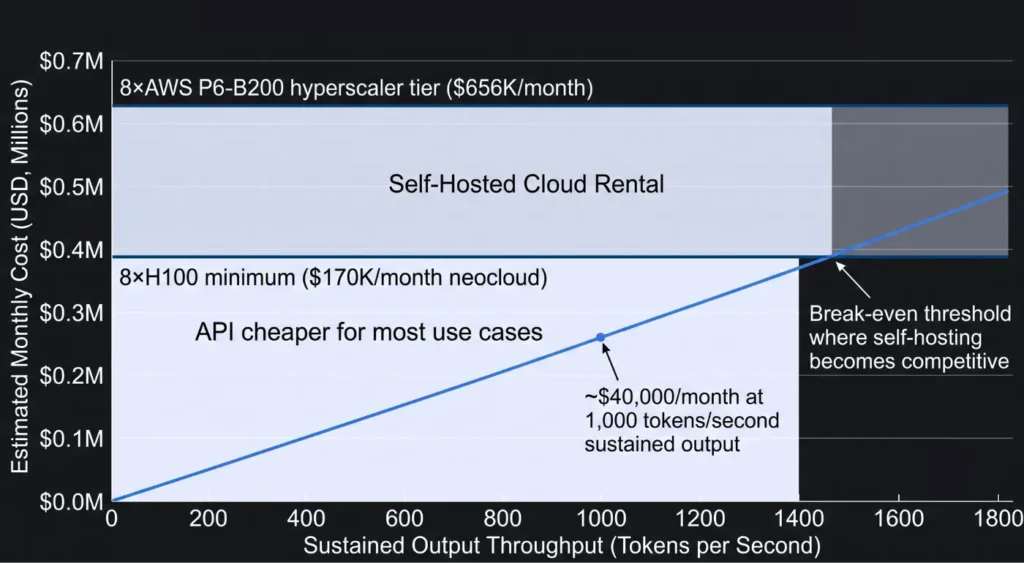
Taking a neocloud on-demand rate of roughly $3.70–$6.00/hr per B200 as representative of the lower end of the market (Spheron Network, priced as of March–June 2026; corroborated by Beam Cloud and GetDeploying B200 pricing trackers), a 64-GPU cluster runs somewhere in the range of $237–$384/hr, or roughly $170,000–$276,000/month at continuous (720-hour) utilization.
Cloud, hyperscaler on-demand
AWS’s P6-B200 instance, an 8-GPU node, is currently listed at approximately $113.93/hr (Vantage instance pricing, June 2026), which works out to roughly $14.24 per GPU-hour. Scaling to 64 GPUs (eight nodes) puts the hourly cost at approximately $911/hr, or roughly $656,000/month at full utilization — nearly four times the low-end neocloud figure for the same aggregate GPU count.
Capital purchase
For organizations considering owning rather than renting, a fully configured GB200 NVL72 rack — 72 Blackwell GPUs in a single rack-scale system with NVLink fabric — runs approximately $3.1 million for the rack-scale server itself, rising to roughly $3.9 million all-in once networking, storage, and other integration costs are included (SemiAnalysis TCO analysis).
Amortized over a typical three-year hardware refresh cycle at a realistic 70% utilization rate, this works out to an effective cost in the range of $150–$200 per GPU-hour-equivalent depending on financing assumptions — a figure that only becomes competitive with cloud rental at very high, sustained utilization, since capital costs are fixed regardless of whether the hardware sits idle.
The capital dynamics here mirror a broader pattern across the AI industry: the upfront cost of competitive infrastructure is rising faster than most organizations can absorb internally, which is why we examined the funding mechanics behind frontier-scale deployments in Why Frontier AI Startups Now Require Billion-Dollar Funding.
On top of any of these paths, power, cooling, and data-center operations typically add 20–30% to cloud-rental costs, and organizations running their own hardware should budget separately for facility costs, redundant power, and specialized operations staff — costs that industry TCO analyses put in the range of an additional $50,000–$100,000 per year per rack, on top of the hardware itself.
Comparing to API pricing
Moonshot’s own hosted API prices Kimi K3 at $3.00 per million input tokens (cache miss), $0.30 per million input tokens (cache hit — a 90% discount), and $15.00 per million output tokens, flat across the full 1M-token context window with no long-context surcharge (Moonshot AI official pricing page). Moonshot has reported cache hit rates above 90% on coding workloads, which materially lowers the effective input cost for cache-friendly usage patterns such as long-running agent sessions or repeated codebase context.
To make the self-hosting-versus-API comparison concrete: at a sustained output rate of 1,000 tokens per second — a substantial but not extreme production workload — that is roughly 86.4 million output tokens per day, which at the $15/million output rate comes to approximately $1,296/day in API output costs alone. A 64-GPU self-hosted deployment at the low end of the cloud-rental range calculated above (~$170,000/month, or roughly $5,667/day) costs more than four times as much per day as the equivalent API output spend — even before accounting for input tokens, which the API charges separately and which self-hosting must also serve.
The self-hosting math also assumes continuous utilization. In practice, production LLM traffic is rarely flat: peak-to-average ratios of 5:1 or higher are common, and cloud GPU rental is charged by the hour whether the accelerators are generating tokens or sitting idle. An organization whose workload is bursty — for example, a coding assistant with daytime peaks and overnight troughs — must provision for peak capacity while paying for that capacity around the clock. API pricing, by contrast, is effectively usage-based: the cost scales with tokens generated, not with hardware reserved. This means the break-even point for self-hosting shifts even higher for spiky workloads.
“Self-hosting Kimi K3 economically outcompetes the API only at very high, sustained throughput, near-continuous utilization, and relatively flat demand — the exact conditions that most organizations struggle to guarantee.”
This comparison understates the true break-even point for API usage in another respect: it ignores input tokens entirely, along with the cost of prompt-engineering iteration, retries, and the reasoning tokens Kimi K3 generates as part of its always-on thinking mode (independent testers have recorded over 13,000 reasoning tokens for a single short task at maximum reasoning effort, according to Simon Willison’s early testing notes).
Once input and reasoning-token costs are folded in, the effective API cost per unit of useful output work is meaningfully higher than the output-token figure alone suggests — which in turn means the throughput level at which self-hosting starts to look favorable is also higher than a naive output-only comparison implies.
The qualitative conclusion holds regardless of the precise crossover point: self-hosting Kimi K3 economically outcompetes the API only at very high, sustained throughput, near-continuous utilization, and relatively flat demand — the exact conditions that most organizations, outside of the highest-volume production deployments, struggle to guarantee.
Deployment TCO: Self-Hosting vs. Hosted API
Choosing between hosting Kimi K3 internally or leveraging Moonshot’s hosted API comes down to throughput, traffic predictability, and total cost of ownership. The following matrix outlines the estimated financial and operational floor across each primary deployment path.
| Deployment Path | Monthly Floor | Primary Operational Bottleneck / Drawback | Ideal Use Case Scenario |
|---|---|---|---|
| Official Hosted API | Pay-per-token ($15/M Output) | Variable costs, data privacy constraints | Spiky, low-to-medium, or unpredictable traffic volumes. |
| Neocloud Rental (64x B200) | ~$170,000 – $276,000/mo | Fixed cost regardless of idle capacity; multi-node latency | High-throughput, flat continuous demand (24/7 workloads). |
| Hyperscaler AWS P6 (64x B200) | ~$656,000/mo | Enterprise markup, high hourly rates | Existing cloud-commit contracts, strict compliance needs. |
| Capital Purchase (GB200 NVL72) | ~$3.9M upfront (~$150–$200/GPU-hr) | Fixed hardware depreciation, facility/power/ops overhead | National labs, hyperscalers, massive long-term scale. |
The Agentic Angle for Kimi K3
Kimi K3’s weakest published category — agentic tool use and computer-operation tasks, where it ranks #6 of 129 tracked models at an average score of 66.5 — deserves attention disproportionate to its position in the overall leaderboard, because it speaks directly to the question most relevant to teams building production AI agent services rather than chasing benchmark position for its own sake.
The broader pattern visible in Kimi K3’s benchmark record is a bifurcation between two different things that get labeled “capability.” On one axis, there is performance on discrete, well-specified evaluation tasks — competitive programming, graduate-level science questions, single-turn coding challenges — where scale and training methodology translate fairly directly into higher scores. Kimi K3’s results on GPQA-Diamond, Terminal-Bench, and Frontend Code Arena sit comfortably in this category, and the model performs well by this measure.
On the other axis, there is the kind of sustained, multi-step, tool-mediated execution that characterizes production agents: maintaining state across many turns, recovering from tool errors, knowing when to ask for clarification rather than proceeding on an ambiguous instruction, and operating within cost and permission boundaries set by an operator.
Kimi K3’s own documentation flags relevant limitations here directly — Moonshot notes that the model can make unprompted decisions when it encounters ambiguity mid-task rather than pausing, and that it is sensitive to having its full reasoning history preserved across a session, with quality degrading if a harness switches models mid-conversation or fails to pass that history back correctly (Amplifi Labs; kingy.ai).
“A model’s headline Intelligence Index position is a weak proxy for how it will behave inside a production agent harness that depends on tool-call accuracy, graceful error recovery, and predictable cost governance.”
For infrastructure teams, the practical implication is that model selection for an agentic product should not default to whichever model tops the aggregate leaderboard. A model’s headline Intelligence Index position, or its performance on academic and coding benchmarks, is a weak proxy for how it will behave inside a production agent harness that depends on tool-call accuracy, graceful error recovery, and predictable cost governance.
Teams building agent services are often better served by evaluating candidate models directly against representative internal workloads — measuring completion rate, retry cost, and failure-mode frequency under the specific harness and permission structure the product will actually use — rather than extrapolating from general-purpose benchmark rankings.
This connects to a broader trend visible across the industry in mid-2026: hiring and role definitions are shifting toward dedicated “AI agent engineer” positions, but the skill set those roles actually require is systems engineering — observability into agent behavior, structured handling of failure modes, cost and permission governance — rather than model selection in isolation.
A model is one component of an agent system, and for the specific dimension of agentic reliability, Kimi K3’s own benchmark profile suggests it is, at present, not obviously the strongest available component even though it leads on several adjacent measures. This is not a criticism unique to Kimi K3; it is a reasonably general observation about the current state of frontier-scale models, where optimization pressure during training has historically concentrated on the benchmarks that get published and compared, which are disproportionately academic and coding evaluations rather than long-horizon agentic reliability metrics.
For organizations that cannot justify K3’s infrastructure floor but still need capable models for production agent workloads, the trade-off between scale and deployability is shifting—something we explored in Why Small Language Models (SLMs) Are Changing Enterprise Adoption.
Open Weights, Closed Gates: The Infrastructure Reality Behind Kimi K3
Kimi K3 demonstrates, credibly and with independent partial verification, that an open-weight model can now sit within a few points of the closed frontier on a broad set of capability benchmarks — coding, multimodal reasoning, graduate-level science knowledge, and web-browsing comprehension among them. That is a genuine milestone for the open-weight ecosystem, and it arrives faster than most observers of the field would have projected a year earlier, when Moonshot’s own market position had eroded significantly following the rise of lower-cost Chinese competitors (VentureBeat).
But the same release also demonstrates, with equal clarity, that “open weights” and “accessible deployment” are not the same claim. A model whose recommended production configuration starts at 64 accelerators, whose BF16 weight set alone exceeds the usable memory of the most capable single-node inference system on the market, and whose realistic self-hosting cost runs from roughly $170,000 to over $650,000 a month depending on the cloud path chosen, is open in licensing terms for most users — the Kimi K3 License permits free use, modification, and distribution, with commercial restrictions that apply only at very high revenue or user-scale thresholds.
Yet that licensing openness does not translate into practical accessibility for the overwhelming majority of organizations, because the computational floor required to use those weights productively remains a form of gatekeeping in its own right. The infrastructure floor here is closer to what a national lab or a hyperscaler operates as a matter of course than to what a mid-sized enterprise typically provisions for a single model deployment.
The more durable framing, for the infrastructure engineers and technical decision-makers this article is aimed at, is that the real frontier under discussion is not model parameter count but deployment economics. Until serving frameworks, quantization techniques, and hardware price-performance compress a model like Kimi K3’s effective footprint by another factor of five to ten, it will remain, for most operators, a research artifact to study and an API product to consume — rather than a system to host directly.
That compression is plausible over time; it is the same trajectory that made earlier generations of frontier-scale models progressively cheaper to serve. But it has not happened yet for models at this parameter count, and planning should proceed on the assumption that it will take time rather than arrive with the weights themselves.
The signal for infrastructure teams evaluating where to direct engineering effort is correspondingly clear. The near-term opportunity is not, for most organizations, in standing up the hardware to host Kimi K3 directly. It is in building the serving optimizations, quantization pipelines, and agentic orchestration layers — the systems-engineering work of making models at this scale tractable, reliable, and cost-governed for a specific production workload — that sit on top of whichever model an organization ultimately chooses to run, whether that is Kimi K3 via API, a smaller open-weight model self-hosted on more modest hardware, or a hybrid architecture that routes different task types to different models.
That is where the engineering effort currently has the most leverage, and it is where the durable business value is likely to accrue, regardless of how the underlying model leaderboard reshuffles over the next several release cycles.
Note on methodology and limitations:
Most benchmark figures in this article come from Moonshot AI’s own launch materials (July 16, 2026), cross-referenced against independent trackers where available. Where independent verification exists — chiefly from Artificial Analysis and BenchLM.ai — the two do not always agree, and the discrepancy is noted explicitly. GPU cloud pricing is unusually volatile in mid-2026; figures cited are dated to their source and should be treated as directional rather than fixed. Kimi K3’s license terms were published on July 27, 2026, as the custom “Kimi K3 License” via Hugging Face, superseding earlier industry speculation of a “Modified MIT” license based on Moonshot’s K2-series precedent.
Sources and Methodology
Benchmarks and capability data
- Moonshot AI launch blog (July 16, 2026): Primary source for architecture details (2.8T parameters, 896 experts, 16 active per token, 1M context window, KDA attention, AttnRes), and self-reported benchmark scores: GPQA-Diamond (93.5%), Terminal-Bench 2.1 (88.3%), BrowseComp (91.2% with compaction, 90.4% without), Humanity’s Last Exam (56.0% with tools, 43.5% without), and MMMU-Pro (81.6%). All scores reported under “max” reasoning-effort setting.
- Arena.ai: Frontend Code Arena leaderboard (#1 ranking, 1,679 Elo).
- BenchLM.ai: Composite leaderboard (#5 of 215 models; #4 of 101 on verified leaderboard), category breakdowns (agentic tool-use #6 of 129 at 66.5; multimodal/grounded tasks #2 of 32 at 89.6), BrowseComp (91.2%), and Humanity’s Last Exam (56.0% with tools).
- Artificial Analysis: Independent Terminal-Bench 2.1 evaluation (~85% vs. Moonshot’s 88.3%); Intelligence Index score (57.11, #4 of 189).
- VentureBeat: Launch coverage and market context (Moonshot’s competitive position, Kimi K3 as “3T-class” system).
- Tom’s Hardware: Architecture summary and benchmark reporting (cited in original article; superseded by direct Moonshot and Arena.ai citations in revised text).
- buildfastwithai.com; kingy.ai: Notes on independent verification lag and max-reasoning-effort caveats.
- Labellerr: GPQA-Diamond corroboration (cited in original article; superseded by “multiple independent trackers” phrasing in revised text).
Architecture and deployment guidance
- Moonshot AI official pricing page: API pricing ($3.00/M input cache miss, $0.30/M input cache hit, $15.00/M output), verified by eesel AI, kie.ai, and emergent.sh.
- Northflank: Production deployment recommendation (64+ accelerators); note that Moonshot has not published a validated minimum-viable GPU count.
- k3nova: Production deployment recommendation (64+ accelerators); MXFP4 quantization scheme and hardware deployment guidance.
- GitHub technical summary: Architecture corroboration (cited in original article; superseded by direct Moonshot citation).
- MoonshotAI/Kimi-Linear (GitHub): KDA attention mechanism description, 3:1 KDA-to-global MLA ratio, and architecture overview.
- Amplifi Labs; kingy.ai: Agentic limitations — unprompted decision-making under ambiguity and reasoning-history sensitivity.
Hardware and VRAM analyses
- Wan 2.7 Kimi K3 VRAM guide: Detailed VRAM breakdowns by component (weights, KV cache, activation, overhead), precision-by-precision budgets (BF16 through Q2), GPU configuration tables, context-length formulas, and deployment testing on H100 clusters with vLLM. Source for: 594 GB BF16 weights; ~20 GB headroom on 8×H100; KV cache at 256 KB/token (BF16); minimum GPU counts by precision; and the 4×H100 experimental / 8×H100 production minimum distinction.
- Wan 2.7 hardware requirements guide: Minimum configuration analysis (cited in original article; consolidated into VRAM guide in revised text).
- Wan 2.7 cost analysis: API cache hit rates and self-hosting comparison framework.
- k3nova hardware guide: MXFP4 quantization-aware training and deployment guidance.
Cloud pricing and TCO
- Spheron Network: Neocloud B200 on-demand rates ($3.70–$6.03/hr, March–June 2026); independent tracking of AWS P6-B200 pricing (~$113–$114/hr, June 2026).
- Beam Cloud; GetDeploying: GPU cloud pricing volatility and neocloud rate corroboration.
- Vantage instance pricing: AWS P6-B200 listing (~$113.93/hr, June 2026).
- SemiAnalysis: GB200 NVL72 TCO analysis (~$3.1M rack, ~$3.9M all-in); facility and operations cost benchmarks ($50,000–$100,000/year/rack).
License and release information
- Hugging Face: Kimi K3 License text (published July 27). Custom permissive license with commercial carve-outs: Model-as-a-Service businesses with aggregate affiliate revenue exceeding $20M over any 12-month period require separate agreement; products/services exceeding 100M MAU or $20M monthly revenue must display “Kimi K3” branding. Internal use and use through Moonshot’s official API or certified partners are exempt.
Additional references
- Kimi Team (Yu Zhang, Zongyu Lin, et al.). “Kimi Linear: An Expressive, Efficient Attention Architecture.” arXiv:2510.26692, 2025. Source for KDA memory and KV-cache reduction claims (up to 75%) and decoding throughput figures (up to 6× at 1M context). Self-reported by Moonshot AI research team.
- Simon Willison’s early testing notes: Reasoning token volume (13,000+ tokens for a single short task at maximum reasoning effort).
- emergent.sh; augmentedmind.substack.com; bleap.finance: Citation relays for Artificial Analysis and BenchLM data (cited in original article; superseded by direct source citations in revised text).
- kimi-k2.org: Deployment guidance relay (cited in original article; superseded by Northflank and k3nova citations).
