


A decade ago, the most successful artificial intelligence systems were built by small teams with modest budgets. A few GPUs, some open-source frameworks, and a novel algorithm were often enough to produce breakthrough results. That era is ending.
Today, training a frontier AI model requires industrial-scale infrastructure: tens of thousands of specialized processors, gigawatts of power, custom data centers, and capital commitments measured in billions of dollars. The most advanced systems are no longer developed like software products. They are built like energy plants, telecom networks, or semiconductor fabs — capital-intensive, long-term, and accessible only to organizations that can mobilize resources at that scale.
This shift is reshaping who can compete at the cutting edge of artificial intelligence. It is concentrating power in a handful of well-funded labs and their partners, while creating a parallel market of smaller, more efficient models for everyone else. It is also raising questions about what happens when the infrastructure beneath AI becomes as important as the intelligence itself.
Understanding how this threshold emerged, why infrastructure has become the dominant cost driver, and what the rising capital intensity of frontier AI means for the industry requires looking at the system as a whole — from the chips and memory inside the servers to the power plants and funding rounds that make them possible.
Why Frontier AI Development Has Become So Expensive
Over the past five years, state-of-the-art AI models have grown from billions to trillions of parameters. Training them now requires massive parallel compute clusters operating continuously for weeks or months, with each major run consuming millions of GPU hours.
In 2024, Epoch AI traces a cost curve that has grown roughly 2.4 to 2.6 times per year, from the original Transformer model’s $1,000 training cost in 2017 to the $80 million to $90 million required for frontier models like GPT-4 and Gemini by 2023. Industry leaders, including Anthropic’s CEO Dario Amodei, now predict that models trained in the coming year could reach $1 billion. This is not occasional R&D spending. It is a recurring industrial process with a large fixed cost base that deepens with each generation.
These workloads demand tightly coupled infrastructure: thousands of accelerators connected via high-speed interconnects so that gradients and parameters can be synchronized across the cluster in real time. A frontier-scale Nvidia H100 cluster, for example, may require tens of megawatts of sustained power — enough to supply a small city — along with petabytes of high-throughput storage and specialized networking hardware to keep utilization high and failures manageable.
The human cost is equally significant. Teams that can design, optimize, and operate such systems command top-tier compensation. A full-stack infrastructure team for a frontier AI lab can easily represent tens of millions of dollars in annual personnel costs, with individual researchers and engineers often earning total compensation packages in the high six to seven figures.
The result is a fundamental redefinition of what it means to build artificial intelligence. Training a frontier model is not “expensive software development.” It is a capital-intensive exercise that combines AI chip procurement, power and cooling engineering, storage and networking architecture, and large research teams.
Yann LeCun’s new startup, AMI, illustrates this shift starkly: founded only months earlier, the company raised $1.03 billion in seed funding in March 2026, explicitly describing the capital as runway for “compute and talent.” That an organization with no product, no revenue, and no commercial track record could secure such investment underscores how concentrated frontier AI spending has become, and how much the economics of the field have changed.
How Compute Infrastructure Is Driving Capital Requirements
The core driver of rising AI capital needs is the infrastructure required to run large-scale training jobs efficiently. Modern AI chips such as Nvidia’s H100 or H200, or AMD’s MI300-class accelerators, cost tens of thousands of dollars per card, and high-density systems with eight GPUs can reach $350,000–$400,000 per node depending on configuration.
At frontier scale, organizations are no longer acquiring a handful of nodes; they are building or leasing clusters comprising thousands to tens of thousands of accelerators, driving total hardware investments into the billions. Next-generation AI chips, such as Nvidia’s Blackwell series (B200 and B300), are expected to further increase both per-node power requirements and system costs.
The B200 192GB SXM model is estimated to cost approximately $45,000–$50,000 per unit, with fully configured server systems exceeding $500,000. Similarly, the B300 follows a comparable pricing trajectory, with individual units around $53,000 and complete DGX B300 systems ranging between $400,000 and $500,000.
These escalating costs significantly raise the capital barrier to entry, far beyond what was required just one generation earlier. Because accelerator manufacturers do not publicly disclose official pricing, these estimates—derived from cloud service provider listings—should be interpreted as informed approximations.
Around the chips, AI data centers must be engineered for extreme power density and cooling. According to Bernstein Research analysis reported by Business Insider in October 2025, building a 1-gigawatt AI data center — large enough to host hundreds of thousands of high-end GPUs — can require on the order of $35 billion, with roughly two-thirds of that cost in silicon alone.
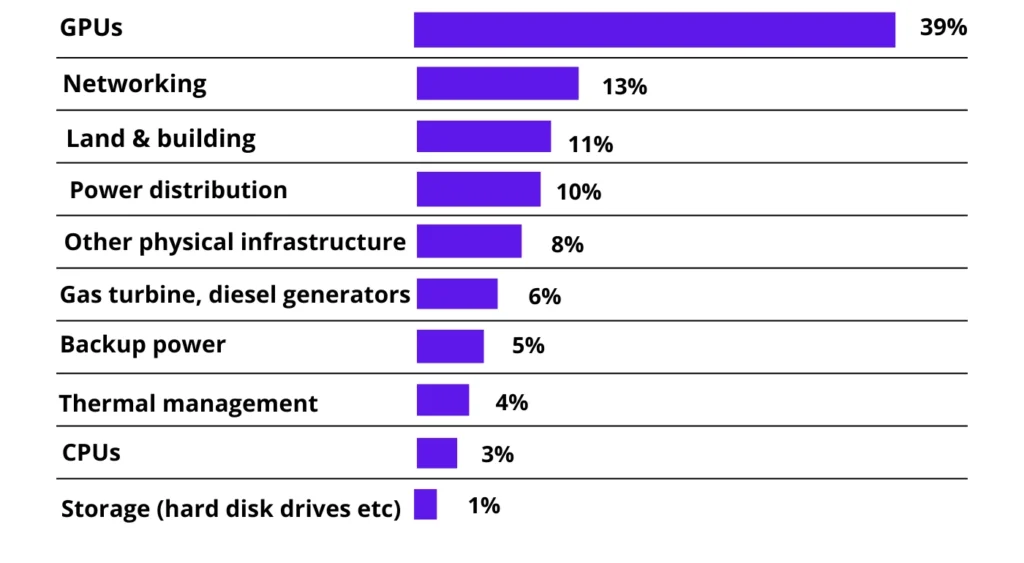
Power infrastructure, cooling systems, high-performance storage, and networking fabrics like InfiniBand or 400GbE add substantial additional cost. A 100-GPU cluster with a high-performance networking fabric may require $400,000–$600,000 in interconnect hardware alone, while annual power and cooling costs can reach six figures depending on local electricity rates and facility efficiency.
High-bandwidth memory (HBM) is another bottleneck that directly impacts cost. HBM capacity and bandwidth largely determine how large a model can fit on a single node and how fast tokens can be generated during inference. As we examined in a prior article, the HBM market is controlled by just three manufacturers, and the complexity of advanced stacks keeps prices high even as demand surges.
Manufacturers are racing to deliver HBM4 and beyond, but supply constraints and stacking complexity mean that memory costs will remain a significant share of AI infrastructure spending for the foreseeable future. In this context, AI infrastructure is not a side consideration: it is the central economic driver of frontier AI development.
Why AI Costs Scale Across the Entire System
The rising cost of artificial intelligence is often blamed on the price of GPUs or the sheer size of modern models. While those factors matter, they don’t fully account for why costs escalate so quickly. The real driver is the system architecture: AI deployments involve multiple tightly coupled layers, and scaling any one layer forces multiplicative scaling in the others.
Compute — typically realized through GPUs and other accelerators — sits at the core of that system. Adding more GPUs enables larger, higher‑performing models, but compute doesn’t act alone. Each accelerator requires a steady stream of data (and thus higher network and storage bandwidth), high‑bandwidth memory (HBM) to feed its processing pipelines, more powerful interconnects, and greater cooling and power capacity.
In short, GPUs are central to modern AI, but their cost effects propagate through an interdependent stack — which is why simply pointing to GPU prices misses the full story.
The same dynamic applies to networking. Large-scale AI training depends on thousands of GPUs working in coordination, exchanging gradients and parameters continuously. Expanding compute capacity increases the volume of data that must move across the system, requiring faster interconnects, more switches, and more complex network architectures. Network complexity does not grow linearly with cluster size; it accelerates as the number of potential connections increases.
Without this investment, additional GPUs sit idle, leading to underutilization that directly erodes return on capital. This is why hyperscalers like Amazon and Microsoft invest heavily in custom silicon — not as luxury features, but as necessities to make expanded compute usable at scale.
Amazon Web Services (AWS) designs its own Trainium accelerators for AI training and Inferentia chips for inference, aiming to bypass traditional GPU bottlenecks and improve price-performance economics. The company has also developed custom networking silicon for its switches, a strategy that traces back to its 2015 acquisition of Annapurna Labs for $350 million, reducing dependency on third-party hardware and optimizing data center efficiency for massive frontier AI models.
Microsoft, for its part, has deployed Maia 200, its most performant first-party AI accelerator, which delivers three times the FP4 performance of Amazon’s third-generation Trainium and 30% better performance per dollar than the previous generation hardware in Microsoft’s own fleet. These investments are not peripheral. Microsoft alone attributed $25 billion of its projected $190 billion in 2026 capital expenditure to higher component costs, underscoring how central silicon economics have become to hyperscaler strategy.
Power and cooling introduce another layer of cost. Each increase in compute density raises the total energy required to operate the system and the complexity of keeping it within safe thermal limits. A frontier cluster may require tens of megawatts, but local grids often cannot deliver that capacity without years of upgrades and permitting. Data centers must be designed to deliver and dissipate large amounts of power reliably, often requiring specialized infrastructure, liquid cooling systems, and long-term planning that extends beyond typical corporate investment horizons.
The scale of this challenge is substantial: A recent research released by Brookings shows that AI data center energy consumption could approach 1,050 TWh by 2026 and is projected to reach 945 TWh by 2030 and 1,200 TWh by 2035, a trajectory that would place the sector among the world’s largest national energy consumers. Market responses reflect the severity of the constraint.
Amazon has committed $500 million toward more than 5 GW of small modular reactor capacity, while Microsoft executed a 20-year power purchase agreement tied to the restarted Three Mile Island reactor supported by a $1 billion Department of Energy loan. Similarly, Alphabet has acquired Intersect Power for $4.75 billion to co-locate data center and generation capacity. xAI, for its part, has committed more than $2.8 billion to portable gas turbines as a near-term bridge for its Colossus facilities.
These dependencies create a compounding effect that is not additive but multiplicative. This manifests most starkly at the facility level. Epoch AI’s modeling of hyperscale AI data centers explicitly notes that scaling from 100 MW to 1 GW of IT power is “not totally linear” — meaning the cost per megawatt does not simply hold constant as facilities expand.
Their updated model estimates an annualized TCO of $8.5 million per MW for a 1-gigawatt facility using NVIDIA GB200 NVL72 systems, with power delivery, cooling, and networking infrastructure accounting for a substantial share of that total. The same dynamic applies within each facility: as compute density rises, memory, networking, and cooling requirements accelerate together. As a result, the marginal cost of each additional unit of compute rises as the system grows, not falls.
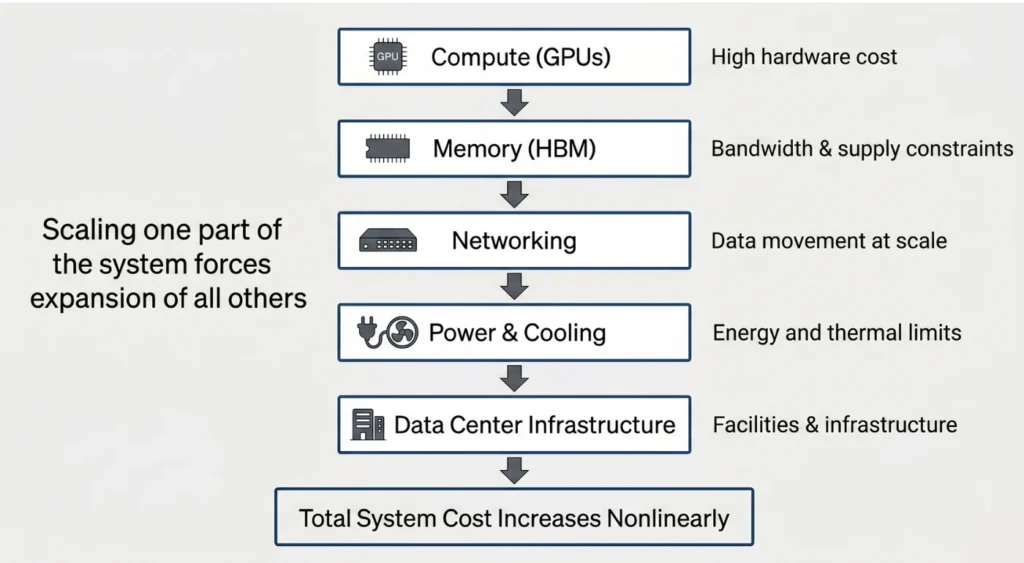
In this sense, AI does not become expensive because models are inherently complex. It becomes expensive because every increase in capability requires expanding a tightly coupled infrastructure stack in which each layer constrains and compounds the others.
How Funding for Frontier AI Has Escalated
The escalation in funding allocated to frontier AI labs, from hundreds of millions to tens of billions, has accelerated sharply. In February 2026, OpenAI announced $110 billion in new investment at a $730 billion pre-money valuation, with SoftBank, NVIDIA, and Amazon as major investors. The company also signed a strategic partnership with Amazon and secured next-generation inference compute with NVIDIA.
xAI, in January 2026, closed a $20 billion Series E round at a reported $230 billion valuation, with participants including NVIDIA, Cisco Investments, and sovereign wealth funds. Anthropic, which raised $30 billion at a $380 billion valuation, has reportedly drawn offers from venture capital firms at valuations up to $800 billion, Reuters reported in April 2026.
The scale of these commitments has redefined what it means to enter the field. In frontier AI labs, the entry ticket alone now starts in the low billions, and AMI’s billion‑dollar seed funding round is a telling example. In other words, the escalation in AI funding is thus a direct response to the growing cost and complexity of AI infrastructure, not a speculative bubble detached from underlying economics.
How Smaller Models (SLMs) Are Changing AI Deployment
In parallel, small language models (SLMs) and domain-specific models are enabling many companies to adopt artificial intelligence without participating in the frontier race. These models can often run efficiently on a handful of GPUs or even CPUs, and they can be fine-tuned on proprietary datasets at a fraction of the cost of training a frontier-scale model from scratch.
For a typical enterprise use case — document search, customer support, basic code assistance — well-optimized SLMs can deliver adequate performance with lower latency, better data control, and more predictable costs.
This trend is encouraging a two-tier structure in the AI market. At the top, frontier AI labs invest billions in compute and infrastructure to push state-of-the-art capabilities and offer general-purpose AI models via APIs and platforms. Below that, a broad ecosystem of companies focuses on application-specific models, fine-tuning, and deployment tooling that leverages existing cloud resources more modestly. These firms can remain capital-efficient, but they typically depend — directly or indirectly — on the infrastructure and models provided by the frontier labs.
In other words, SLMs are reducing the cost of AI deployment for most organizations, but they do not change the economics at the very top. Training the next generation of frontier AI systems still demands large-scale data centers, specialized hardware, and multibillion-dollar funding rounds. The gap between standard AI deployments and frontier development is widening.
The capital barrier is a barrier to foundation model training, not to AI adoption. Most organizations will build value not by replicating billion-dollar infrastructure, but by leveraging it — through fine-tuning, retrieval-augmented generation, and domain-specific deployment of smaller models, with API access to frontier capabilities where needed. That gap is not a threat to most businesses. It is a signal to focus on application rather than replication.
A Capital‑Intensive Future for Frontier AI
Frontier AI has entered a new phase. Labs that aim to shape the next generation of AI systems now need to plan in gigawatts, petabytes, and tens of thousands of accelerators, not just in models and datasets. As cumulative AI infrastructure spending is projected to approach $7.6 trillion through 2031, the structure of the industry is likely to solidify around a small number of players that can mobilize capital, control supply chains, and integrate distribution at scale.
Those outside this concentrated core will still build valuable businesses, but mostly on top of platforms defined by the frontier AI labs. The economic geography of AI is being redrawn, and the most expensive real estate is the infrastructure beneath the models.
This concentration raises questions that extend beyond market structure. As foundational models increasingly underpin economic and social systems, the control of AI infrastructure may invite regulatory scrutiny akin to that faced by telecom and energy utilities. National governments are already intervening through export controls on AI chips, subsidies for domestic data center construction, and strategic partnerships with frontier labs. The future of frontier AI will be shaped as much by policy and capital as by algorithms and data.
In this sense, artificial intelligence does not become expensive because models are inherently complex. It becomes expensive because every increase in capability requires scaling a tightly coupled infrastructure stack in which each layer — compute, memory, networking, power — constrains and compounds the others. Progress at the frontier is no longer defined solely by advances in model design, but by the ability to expand and sustain the systems that support them. The age of billion-dollar AI funding rounds is not an anomaly. It is the new baseline.
This article is being provided for educational purposes only. The information contained in this article does not constitute a recommendation from Intellaix to the recipient, and Intellaix is not providing any financial, economic, legal, investment, accounting, or tax advice through this article or to its recipient.
Sources and references:
- Epoch AI, June 2024. “How much does it cost to train frontier AI models?”
- Semianalysis, June 2024. “100,000 H100 Clusters: Power, Network Topology, Ethernet vs InfiniBand, Reliability, Failures, Checkpointing”
- Reuters, March 2026. “Ex-Meta AI chief Yann LeCun’s AMI raises $1.03 billion for alternative AI approach”
- Jarvis Labs, March 2026. “NVIDIA H100 Price Guide 2026: GPU Costs, Cloud Pricing & Buy vs Rent”
- Jarvis Labs, January 2026. “NVIDIA H200 Price Guide 2026: GPU Cost, Rental & Cloud Pricing”
- Northflank, August 2025. “How much does an NVIDIA B200 GPU cost?”
- Spheron, April 2026. “NVIDIA B300 (Blackwell Ultra) Specs, Pricing, and Benchmarks (2026)”
- Business Insider, October 2025. “Why Nvidia is worth $5 trillion: Inside a $35 billion, 1 gigawatt AI data center”
- Lenovo. “What is Infiniband?”
- FiberMall, August 2024. “The Future of Networking: 400GbE Ethernet Explained”
- Introl, April 2026. “GPU Infrastructure TCO Model: 5-Year Cost Analysis for Enterprise AI”
- AWS. “Improve performance, lower costs, and enhance security with AWS silicon”
- The Information. “Amazon Steps Up Silicon Ambitions With New Networking Chip”
- Microsoft, January 2026. “Maia 200: The AI accelerator built for inference”
- Business Insider, May 2026. “Why Big Tech’s $700 billion AI splurge is misleading”
- Brookings, April 2026. “Global energy demands within the AI regulatory landscape”
- Amazon, February 2026. “Amazon continues to be one of the world’s leading corporate purchasers of carbon-free energy”
- AP News, November 2025. “Energy Department loans $1B to help finance the restart of nuclear reactor on Three Mile Island”
- Alphabet Investor Relations, December 2025. “Alphabet Announces Agreement to Acquire Intersect to Advance U.S Energy Innovation”
- Wired, May 2026. “SpaceX Is Spending $2.8 Billion to Buy Gas Turbines for Its AI Data Centers”
- Epoch AI, May 2026. “Servers account for 60% of the total cost of ownership of a one-gigawatt AI data center”
- OpenAI, February 2026. “Scaling AI for everyone”
- xAI, January 2026. “xAI Raises $20B Series E”
- Reuters, April 2026. “Anthropic draws VC interest at up to $800 billion valuation, Business Insider reports”
- Hugging Face, February 2025. “Small Language Models (SLM): A Comprehensive Overview”
- Goldman Sachs, May 2026. “Tracking Trillions: The Assumptions Shaping the Scale of the AI Build-Out”
