


The GPU has become the defining symbol of the AI era—coveted, expensive, and in perpetual short supply. Organizations measure their AI ambitions in GPU counts, treating these chips as the primary unit of progress. Investors track procurement as a proxy for competitive position. The hardware arms race is real, and GPUs—dominated by Nvidia—sit at its center.
What this fixation overlooks is that GPUs, on their own, are insufficient. A single GPU, however powerful, can only do so much. The models that define the current frontier of AI—systems with hundreds of billions of parameters, trained on datasets of staggering scale—require thousands of chips working in close coordination.
When this happen, the connections between them become just as important as the chips themselves. This is where AI networking plays its crucial role: enabling the massive data transfers that keep distributed training synchronized. It is not a secondary concern. It is a fundamental constraint that determines whether capital invested in compute translates into usable performance—or into expensive, idle hardware.
To understand why networking now shapes the economics and strategy of AI infrastructure, it is necessary to look closely at how data moves between GPUs at scale, at the technologies that make this possible, and at the efficiency gaps that separate well-designed clusters from stranded capital.
What AI Networking Means and Why it Matters
AI networking refers to the high-performance inter-node infrastructure that connects thousands of GPUs across a cluster, enabling the massive data exchanges required for training large AI models. Within individual servers, technologies such as NVLink handle communication between neighboring GPUs; AI networking operates at the layer above, linking servers together into a unified system.
To see why this matters, consider what happens during the training of a large neural network. The process is not static: data feeds through the model, errors in outputs are measured, and the model’s parameters adjust via gradients—over and over again, billions of times. Each adjustment is driven by backpropagation, which calculates how every parameter contributed to the error. In a distributed system where the model is spread across thousands of GPUs, those gradients must be shared among all participating chips before the next round of adjustments can begin.
This means that GPUs in a training cluster are not working independently. They are in constant communication, continuously exchanging information about what they have learned from their respective slices of data. The network connecting them is the infrastructure through which that exchange happens. In practical terms, it determines how much data can move between chips at any given moment and how quickly that data arrives.
These two properties—volume and speed—are captured by the concepts of bandwidth and latency. Bandwidth describes the capacity of a network connection: how much data it can carry simultaneously, typically measured in gigabits per second (Gb/s). In AI training, bandwidth matters because gradient synchronization is an all-reduce operation—every GPU must send its gradients to every other GPU, creating a bulk data transfer challenge that grows with cluster size.
Latency describes the delay between sending a piece of data and having it received, usually measured in microseconds or milliseconds. In AI systems, latency matters because training uses synchronous updates: all GPUs must reach the same checkpoint before proceeding. Even modest delays create waiting time that ripples across the entire cluster.

Together, bandwidth and latency define the communication environment in which AI compute operates. A cluster with excellent hardware but poor networking is analogous to a team of specialists who must agree on every decision before proceeding, but can only exchange notes through a narrow, slow pipe—the individual capability exists, but collective progress stalls.
Why Modern AI Systems Depend on Fast Communication
The reason coordination matters so acutely in frontier AI training comes down to the mathematics of distributed learning. When a model is too large to fit on a single GPU—and frontier models today exceed the memory capacity of even the most advanced AI chips—it must be partitioned across many processors. Different GPUs hold different parts of the model, process different portions of the data, or both.
This approach, broadly called distributed training—a concept detailed by MinIO, a company that builds high-performance storage for AI infrastructure—allows organizations to work at scales that would otherwise be physically impossible. But it introduces a fundamental dependency: the GPUs must stay synchronized with one another throughout the training process. Synchronization means that before any chip can apply the lessons learned from its portion of the data, all chips must share what they have learned.
This process—aggregating gradient information from thousands of GPUs and distributing the updated parameters back to each of them—happens continuously at every training step. Within a single step, it cannot be skipped or significantly delayed without degrading the quality of the training run or producing incorrect results. (Gradient accumulation, which batches updates across multiple steps, operates at a higher level and does not eliminate the per-step synchronization requirement.)
The scale at which this happens in modern AI development is substantial. Meta’s technical report on Llama 3 405B describes a training infrastructure of 16,384 Nvidia H100 GPUs distributed across 2,048 interconnected nodes, with 400 Gbps interconnects between processors. At that scale, the volume of data moving through the network at any given moment is not modest. The aggregate interconnect capacity across such a cluster reaches into the terabits per second range—and in larger or more extended training runs, the cumulative data movement scales further still.
This represents a significant step up from the previous generation: Nvidia A100-based clusters typically operated at 200 Gb/s per GPU, while the H100 generation doubled that to 400 Gb/s, and emerging B300 platforms are pushing toward 800 Gb/s.
Every second of training at this scale involves a volume of data transfer that would, under ordinary circumstances, seem extraordinary. At the frontier of AI, it is simply the baseline. When the network can handle this volume efficiently, GPUs remain productive—processing data and learning continuously. When the network cannot keep pace, GPUs stall. They finish their local computation, then wait for the information they need to proceed. That waiting is not idle in a harmless sense. It represents compute capacity that has been paid for and is not being used.
The Bandwidth Explosion in AI Networking
The communications demands of AI training have grown in rough proportion to model scale, which has also grown dramatically. This puts considerable pressure on AI networking infrastructure. As mentioned by Epoch AI in its research released in February 2026, the amount of computation required to train frontier AI models has increased at five times per year since 2020. Each step up in AI model size brings with it a corresponding increase in the volume of data that must move between GPUs during training.
Current-generation high-performance networking infrastructure, such as that deployed in Nvidia H100-based clusters, is designed to handle around 400 Gb/s per GPU. This level of performance is typically achieved using two dominant technologies: InfiniBand, an ultra-high-speed, low-latency interconnect primarily used in supercomputing and AI environments, and high-speed Ethernet fabrics, which provide flat network architectures connecting thousands of servers and accelerators with massive scalability.
The trade-offs between them—and why organizations choose one over the other—are discussed in the infrastructure section that follows. Across a cluster of thousands of GPUs, aggregate network bandwidth reaches into the terabits per second range. For very large and sustained training runs, the total data moved through the network over the course of the run operates at petabyte scale.
To translate that into something more tangible: a frontier AI training cluster sustains a rate of data transfer comparable to moving the entire contents of a major streaming service’s catalog—not once, but continuously, hour after hour, for weeks at a time. The networking layer is not shuffling small messages between chips. It is sustaining a throughput that few other applications in computing have ever demanded.
This creates a hardware challenge that is distinct from, though related to, the challenge of GPU procurement. The chips themselves require specialized interconnects, high-speed cables, and switching equipment capable of sustaining these data rates without introducing delays or errors. That infrastructure must be designed, procured, installed, and maintained alongside the compute hardware—and unlike the GPU market, where at least a dominant supplier exists, the networking layer draws on a different set of vendors, standards, and trade-offs. For hyperscalers building at scale, this means navigating a more fragmented supply landscape with fewer single-source solutions.
When AI Networking Becomes the Bottleneck
The relationship between networking quality and training efficiency is not linear. Below a certain bandwidth threshold, GPUs stall entirely; above it, returns diminish gradually. When networking is the constraint, the entire system is held back—not just the communication layer, but the compute it serves.
The practical consequence of inadequate networking is GPU underutilization. AI chips that are waiting for network operations to complete are not processing data. According to Together AI—a specialized AI infrastructure provider—poor network configuration can reduce effective GPU utilization to somewhere between 40% and 50%.
Consider what 50% utilization means in practice. An organization that has invested $100 million in GPU hardware is effectively operating with the productive output of $50 million worth of compute if its networking cannot keep pace. The remaining capacity exists on paper, consumes power, occupies physical space, and requires maintenance—but produces nothing useful.
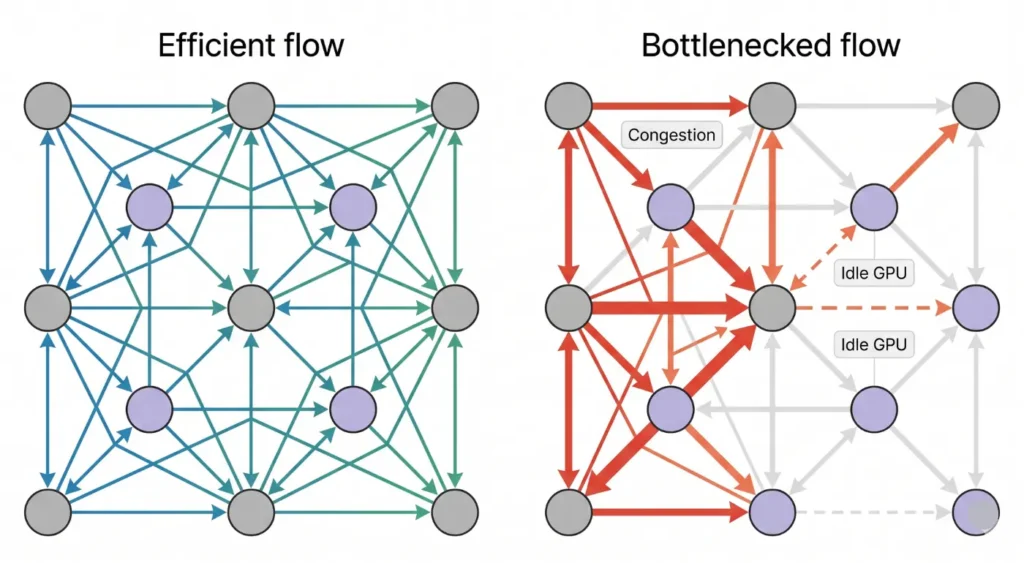
This phenomenon, sometimes called stranded compute or compute stranding, is one of the more consequential inefficiencies in AI infrastructure, and it originates not from the GPUs themselves but from the connections between them.
As the cost of training the most advanced AI models reaches hundreds of millions of dollars and could, according to some projections, amount to billions per run, infrastructure inefficiencies are no longer marginal. At this scale, networking becomes a critical determinant of the economic performance of systems, shaping the ability to convert investments in computing power into real operational capabilities.
A training run that takes twice as long as necessary because of networking inefficiency does not just waste time—it consumes additional power, occupies infrastructure that could be used elsewhere, and delays the outcomes of the entire research or product development cycle. The cost of underinvestment in networking is not abstract. It compounds across every hour of a training run. And as the next section shows, the difference between efficient and inefficient networking is not merely theoretical—it has already shaped the competitive landscape of frontier AI.
Llama vs DeepSeek: Two Approaches to AI Networking Efficiency
The strategic importance of networking efficiency is perhaps most clearly illustrated by comparing two approaches to frontier AI training that became prominent in recent years.
Meta’s Llama 3 training represented a scale-first, infrastructure-intensive approach. With over 16,000 Nvidia H100 GPUs and the sophisticated networking required to coordinate them, it exemplified the prevailing model of frontier AI development: deploy massive, highly optimized compute resources to train at a scale that competitors cannot easily match. Meta’s implementation relied on four-dimensional (4D) parallelism—Fully Sharded Data Parallelism (FSDP), Tensor Parallelism (TP), Pipeline Parallelism (PP), and Context Parallelism (CP)—to distribute model parameters, activations, and training data across tens of thousands of GPUs while maintaining high utilization.
The approach is effective, but it is also resource-intensive and infrastructure-dependent. It requires not just GPUs, but the full stack of high-performance networking, power, and facilities to support them.
DeepSeek, a Chinese AI research organization, attracted significant attention with a different approach. According to an arXiv paper, the V3 model was trained using only 2,048 Nvidia H800 chips, a bandwidth-constrained variant of the H100 designed for export compliance (with reduced NVLink bandwidth of 400 GB/s compared to the H100’s 900 GB/s)—DeepSeek’s training methodology placed heavy emphasis on communication efficiency. It used FP8 (8-bit floating point) precision training to reduce the volume of data exchanged between GPUs, deployed a Multi-Plane Fat-Tree topology that replaced conventional three-layer network designs with a more efficient two-layer structure, and implemented DualPipe to overlap computation with communication, minimizing idle time during training.
The result was a training process that achieved results competitive with models trained on significantly larger infrastructure, while placing considerably lower demands on networking.
This contrast illustrates a broader strategic divergence in the industry: scale-first approaches deploy massive resources with state-of-the-art optimization, while efficiency-first approaches achieve comparable results with fewer resources through architectural innovations.
The comparison is instructive not because it suggests that networking optimization is a substitute for compute at all scales—it is not—but because it demonstrates that networking efficiency is a genuine technical lever. Organizations that invest in understanding and optimizing their communication patterns can, in at least some contexts, achieve meaningful results with less raw infrastructure. The frontier of AI is not defined purely by who has the most GPUs. It is also shaped by who uses their interconnects most effectively—and, as the next section examines, by the infrastructure choices that make such efficiency possible.
The Infrastructure Behind AI Networking
In an educational video from Scan Business—a UK-based technology reseller and Nvidia Elite Partner with over 40 years of experience—they explain that the networking landscape for high-performance AI infrastructure centers on two dominant approaches, each with distinct hardware and protocol characteristics.
InfiniBand is the technology most closely associated with high-performance AI training clusters. Much of this ecosystem has been shaped by Nvidia through its Mellanox acquisition and continued investment in networking hardware. InfiniBand network cards feature RDMA (Remote Direct Memory Access) offloading, which allows the network card to directly access system memory without CPU involvement—significantly improving performance and reducing latency.
Developed originally for supercomputing environments, InfiniBand provides extremely low latency and high throughput, making it well-suited for the tight synchronization demands of distributed training. Nvidia offers InfiniBand Quantum switches and ConnectX network cards that deliver speeds up to 400 Gb/s. The largest frontier AI clusters have typically relied on InfiniBand for their internal interconnects, functioning as a specialized data highway engineered for environments where communication speed is the primary constraint.
Ethernet, the technology that powers most of the world’s enterprise and internet infrastructure, is increasingly present in AI data centers as well—particularly in cloud-based deployments where cost flexibility and compatibility with existing infrastructure matter. While standard Ethernet originally handled network connections while leaving memory access tasks to the CPU, Mellanox (now Nvidia) integrated RDMA technology into its Ethernet products as RoCE (RDMA over Converged Ethernet)—closing much of the performance gap with InfiniBand for certain workloads.
Nvidia offers Ethernet Spectrum switches and ConnectX network cards that reach up to 800 Gb/s in the latest generation, and the broader ecosystem of vendors and compatible equipment makes Ethernet attractive for organizations that prioritize flexibility and supply chain diversity.
The choice between them reflects deeper strategic calculations. InfiniBand’s native RDMA implementation allows AI chips to read and write memory across the network without CPU involvement—critical for minimizing synchronization overhead. Ethernet’s RoCE-based approach achieves similar capabilities, but implementation complexity and consistency vary across vendors and deployments. Hyperscalers building at scale often deploy both: InfiniBand for performance-critical training pods, Ethernet for inference and general-purpose workloads.
These trade-offs are visible in how major training clusters are actually built. The Llama 3 infrastructure report described earlier used a three-layer Clos network built on Arista 7800 switches with RoCE-based interconnects—an Ethernet-native approach optimized for its specific topology. By contrast, the DeepSeek V3 architecture paper referenced above employed a two-layer Multi-Plane Fat-Tree (MPFT) over InfiniBand, reducing network hops and inter-node communication bottlenecks. Both achieved high performance, but through different hardware and protocol choices.
These individual deployment choices scale into strategic infrastructure decisions. Introl’s industry analysis offers a concrete example: Meta standardized on Ethernet across its broader AI infrastructure after discovering that InfiniBand’s 15% performance advantage could not justify 2.3x higher total cost of ownership (TCO) across a 600,000 GPU fleet. This illustrates how hyperscalers weigh marginal performance gains against multiplicative cost effects at scale—a calculation that drives many organizations toward Ethernet for general-purpose workloads even when InfiniBand remains the choice for performance-critical training pods.
Beyond these two dominant approaches, proprietary interconnect solutions have emerged from major technology companies developing custom AI infrastructure. Google’s latest TPU pods use custom Optical Circuit Switches (OCSs), and Amazon’s Trainium2 instances integrate purpose-built networking for scale-out training, while Microsoft’s Cobalt 200 server blades integrate advanced networking with custom silicon and Azure Boost as part of a unified infrastructure stack.
These reflect the same logic that has driven investment in custom AI silicon: at sufficient scale, general-purpose solutions leave optimization room that proprietary designs can capture. For organizations operating below that scale, however, the ecosystem breadth and interoperability of standard InfiniBand or Ethernet remain decisive advantages.
The Economics of AI Networking Infrastructure
Networking is often treated as a line item in AI infrastructure budgets rather than a strategic consideration in its own right. However, cost breakdowns from frontier training analyses suggest it deserves more attention. According to Luccioni and Strubell’s arXiv analysis (February 2025) of frontier AI training costs, cluster-level networking accounts for roughly 9% to 13% of total training cost, placing it as a consistent and non-trivial component of overall system economics.
A useful way to frame this is in relation to GPU spending. Because AI chips and accelerators dominate total cost, networking investment tends to scale alongside them. Given the relative cost shares, this implies that on the order of 15 to 20 cents of networking infrastructure may be required for every dollar spent on compute. This ratio is not fixed—it varies with cluster architecture, workload characteristics, and system design—but it consistently positions networking as a meaningful component of total AI infrastructure cost rather than a rounding error.
Infrastructure investment analyses suggest similar proportions at the data center level. According to a January 2025 Bernstein analysis cited by Investing.com, networking represents approximately 13% of total AI data center capital expenditure—spread across switches, cabling, network accelerators, and connectors—with switches alone accounting for roughly 3% of total spend.
More importantly, an organization that optimizes its networking infrastructure can extract more value from the compute it already has. In an environment where GPU supply is constrained and lead times stretch to months, the ability to improve effective utilization of existing AI chips without adding hardware is genuinely valuable. For hyperscalers operating at scale, a networking upgrade that improves utilization by 10% across an existing fleet can represent tens of millions of dollars in recovered productive capacity—often at a fraction of the cost of procuring equivalent new GPUs.
Networking optimization is, in this sense, a complement to hardware procurement rather than a substitute for it. But as the next section examines, the strategic implications extend beyond individual cost calculations to questions of supply chain control, vendor dependence, and competitive positioning.
The Strategic Importance of AI Networking
The growing recognition of networking as a critical infrastructure layer has begun to reshape how the largest AI organizations think about their investments. Nvidia, whose GPUs dominate frontier AI training, has invested substantially in networking technology through its acquisition of Mellanox—the dominant provider of InfiniBand infrastructure—and its ongoing development of networking products under the Nvidia Networking brand. This reflected a strategic judgment that AI infrastructure is not a collection of discrete components but a system, and that controlling the full stack—from GPU to interconnect—was necessary to maintain system-level performance and avoid bottlenecks outside the chip.
Hyperscalers—the large cloud and technology companies spending tens to hundreds of billions of dollars annually on AI infrastructure—have similarly moved to control more of their networking stack. Custom-designed switches, proprietary optical interconnects, and purpose-built cluster networking architectures have become common at the largest scales. The motivation is partly cost efficiency at volume, but it is also about removing external dependencies in an area that has proven strategically critical. Organizations that rely entirely on third-party networking equipment are subject to the same supply constraints and pricing dynamics that affect GPU procurement. Developing proprietary alternatives reduces that exposure.
This pattern—vertical integration into networking as a strategic response to infrastructure dependence—mirrors what has happened in other parts of the AI infrastructure stack. The same logic that drove Google’s TPU, Amazon’s Trainium, and Microsoft’s custom silicon investments is now driving investment in custom networking. At sufficient scale, every layer of the infrastructure becomes a potential competitive advantage or a potential vulnerability, and sophisticated organizations are increasingly treating networking with the same seriousness they bring to compute. The network may be the hidden backbone of AI infrastructure, but for those building at the frontier, it is no longer hidden—it is a primary field of competition.
Infrastructure as an Interconnected System
The story of AI infrastructure cannot be told through any single component. Compute, memory, power, and networking are interdependent elements of a system, and the performance of that system is bounded by whichever element is most constrained. While High-Bandwidth Memory (HBM) keeps processors supplied with data, the physical reality of power infrastructure limits how many GPUs can be co-located in a single facility.
This system is now hitting a thermal wall, where higher networking speeds require significantly more power. As clusters move toward 800Gb/s and 1.6Tb/s speeds, the shift from passive to active optical cabling significantly increases power consumption per switch. High-density networking equipment at these data rates can add substantial thermal load to already constrained facilities, compounding the power challenges discussed in our analysis of AI infrastructure energy demands.
As the industry shifts from training to serving, AI networking demand is expected to grow rapidly. Inference workloads require different traffic patterns—bursty, latency-sensitive, and geographically distributed—placing new demands on networking architectures optimized for bulk gradient synchronization. Frontier AI models that were trained in centralized clusters must now be deployed across edge nodes and regional data centers, extending the networking challenge from inter-GPU coordination to global traffic management.
Improve one element while neglecting another—such as cooling or power delivery for high-density switches—and the bottleneck simply moves. Sophisticated organizations, including hyperscalers operating at global scale, are now treating networking and power with the same seriousness they bring to compute.
Understanding AI infrastructure as a system rather than a collection of parts changes how investment decisions should be made. The question is not simply how many GPUs an organization can acquire, but whether those GPUs are connected to sufficient memory, supported by adequate power infrastructure, and linked by networking designed to coordinate them efficiently.
A cluster that excels on three of those dimensions while failing on the fourth is not a high-performance AI system. It is an expensive reminder that capability requires coherence.
The organizations that have recognized this most clearly are investing not in individual components but in integrated systems—designing clusters from the ground up with all four elements in mind, making trade-offs deliberately rather than by default, and treating networking not as an afterthought but as a co-equal part of the AI infrastructure problem.
Modern AI systems, in the end, are not simply built on compute. They are built on the ability to move data efficiently across increasingly large and complex infrastructure—to keep thousands of chips in communication, in synchronization, and in productive use. The GPU may be the symbol of the AI era, but the network is the architecture through which it actually functions. In practice, AI networking determines whether frontier AI systems operate efficiently at scale. Overlooking it is not merely a technical oversight. It is a strategic miscalculation whose effects accumulate across training workloads, inference operations, and infrastructure investments.
This article is being provided for educational purposes only. The information contained in this article does not constitute a recommendation from Intellaix to the recipient, and Intellaix is not providing any financial, economic, legal, investment, accounting, or tax advice through this article or to its recipient.
Sources and references:
- Nvidia, March 2023. “What Is NVLink?”
- Nvidia, October 2024. “Advancing Performance with NVIDIA SHARP In-Network Computing”
- Google Cloud, August 2025. “Taming the stragglers: Maximize AI training performance with automated straggler detection”
- MinIO, December 2025. “What is Distributed Training? Key Considerations for Enterprise Leaders”
- Meta, July 2024. “The Llama 3 Herd of Models”
- Nvidia. “Introduction to the NVIDIA DGX A100 System”
- Nvidia, March 2022. “NVIDIA Hopper Architecture In-Depth”
- Nvidia. “NVIDIA HGX B300 Baseboard”
- Epoch AI, February 2026. “Trends in Artificial Intelligence”
- Lenovo. “What is Infiniband?”
- Intel. “Deliver High-Performance Networking on Ethernet”
- Together AI, January 2026. “Inside multi-node training: How to scale model training across GPU clusters”
- Epoch AI, June 2024. “How much does it cost to train frontier AI models?”
- ACM Digital Library, June 2025. “Scaling Llama 3 Training with Efficient Parallelism Strategies”
- arXiv, December 2025. “Insights into DeepSeek-V3: Scaling Challenges and Reflections on Hardware for AI Architectures“
- Epoch AI, December 2024. “What did US export controls mean for China’s AI capabilities?”
- Epoch AI, January 2025. “What went into training DeepSeek-R1?”
- Scan Business, May 2023. “What is NVIDIA Networking and what happened to Mellanox?”
- Introl, March 2026. “InfiniBand vs Ethernet for GPU Clusters: 800G Network Architecture Decision Guide”
- Semianalysis, March 2023. “Google OCS Apollo: The >$3 Billion Game-Changer in Datacenter Networking”
- AWS Amazon. “AWS Trainium”
- Microsoft Azure, January 2026. “Silicon to Systems: What powers Microsoft’s AI Infrastructure”
- arXiv, February 2025. “The rising costs of training frontier AI models”
- Investing.com, January 2025. “How much does a GW of data center capacity actually cost”
- Statista, April 2026. “Big Tech’s AI Spending to Reach $725 Billion in 2026“
