


There is a common assumption that progress in artificial intelligence (AI) is fundamentally a software problem—that the breakthroughs shaping the field emerge from mathematical insight, elegant code, and research ingenuity. That assumption, while not entirely wrong, is increasingly incomplete. Over the past several years, a quieter but more consequential shift has taken place: the limiting factor in artificial intelligence development has migrated toward AI compute capacity and infrastructure.
The models defining the frontier of the field are not simply smarter than their predecessors—they are vastly more expensive to build and run, and access to the infrastructure required to build them has become a strategic resource in its own right. This shift has made AI compute infrastructure a defining factor in how modern AI systems are built, scaled, and delivered to users at scale.
Understanding this shift requires stepping back from the model headlines and looking at the underlying economics and infrastructure of modern AI. What emerges is a picture in which AI compute—measured in processing capacity, memory bandwidth, energy consumption, and capital investment—has become the foundational constraint shaping which organizations can participate in frontier AI, at what cost, and with what consequences for the broader industry.
How AI Compute Demand Has Evolved
The numbers describing AI’s computational growth are striking not because they are large, but because of how consistently they compounded for more than a decade—and because of how their meaning has shifted more recently.
According to an Epoch AI report, the compute used to train frontier AI models grew at roughly 4–5 times per year between 2010 and 2024. To appreciate what this meant in practice, consider that the most capable models developed between 2012 and 2022 required roughly ten thousand times more compute than the systems that seemed impressive only a decade earlier. That pace reflected a widely held view in the research community that scale—more data, more parameters, and more computation—produced reliable improvements in capability.
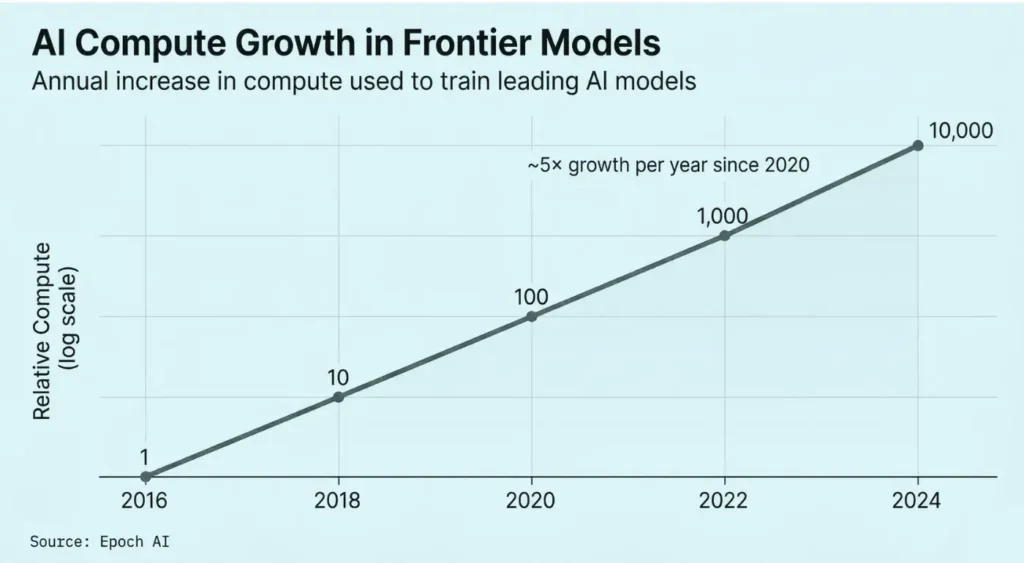
But the trajectory has changed. Based on Omdia research released in April 2026, growth in the largest frontier models has slowed to roughly 5% annually in parameter terms since 2021. This does not mean the industry has stopped building large models, nor that the scope of AI compute demand has narrowed. Projections from arXiv suggest that training runs for next-generation frontier models could exceed $1 billion by 2027. Yet the cost to train a model of equivalent capability to earlier frontiers has fallen sharply—driven by algorithmic efficiency, better hardware utilization, and the rise of open-weight alternatives.
The DeepSeek-V3 model, released in late 2024, illustrates this tension. Widely reported figures placed its final training run at roughly $5.5 to $6 million in GPU rental costs. However, SemiAnalysis estimates the full development investment—including hardware, months of architecture experimentation, and substantial GPU hours for techniques such as Multi-Head Latent Attention—exceeds $500 million. The $6 million figure reflects only the marginal cost of the final pre-training run, not the total capital required to reach that point. This distinction matters: algorithmic efficiency compresses the cost of reproducing a given capability level, but it does not eliminate the capital required to discover and validate the methods that make such efficiency possible.
A similar pattern appears at the frontier. OpenAI’s GPT-5, released in 2025, reportedly used less pre-training compute than its predecessor, GPT-4.5, relying instead on scaled post-training reasoning techniques that yielded better marginal returns. Epoch AI analysis released in September 2025 suggests this reduced direct training costs by roughly an order of magnitude. However, the total development cost likely rose, because extensive experimentation, data collection, and iterative testing preceded the final run. The compute shifted from the headline training phase to the research and development pipeline.
This dynamic defines the current era of AI compute demand. As of early 2026, Epoch AI reports that pre-training compute efficiency improves by approximately 3x per year — meaning the same performance can be achieved with roughly one-third as much compute annually. Including post-training innovations and downstream optimizations, informed estimates place overall algorithmic progress closer to 4–4.5x per year, though these figures carry substantial uncertainty and vary significantly across domains and model scales.
The result is that while frontier labs spend more in absolute dollars to push beyond current capability, the cost of matching yesterday’s frontier falls continuously. The constraint is no longer a single exponential curve of pre-training scale. It is a more complex picture in which training efficiency, inference volume, and workload diversity all compete for infrastructure capacity.
What AI Compute Actually Means: From GPUs to Full-Stack Infrastructure
The word compute is used frequently in discussions of artificial intelligence, often without much clarification. In its most practical sense, AI compute refers to the processing infrastructure used to train and operate large AI models. At the center of this infrastructure are graphics processing units — GPUs — such as Nvidia’s H100 and H200, which are dense arrays of processing cores capable of executing thousands of mathematical operations in parallel. This parallel architecture is exceptionally well-suited to the matrix calculations that underpin neural network training and inference.
But AI compute is not limited to GPUs, nor to training. Modern AI workloads span a spectrum of compute types. Training remains the most visible phase: large clusters of GPUs running synchronized for weeks to optimize model weights. Inference — the process of running trained models to generate responses, predictions, or decisions — now constitutes the dominant share of AI compute consumption in production environments.
In a YouTube video released by IBM Technology, Martin Keen, a master inventor at IBM, breaks down the AI lifecycle, noting that approximately 90% of an AI model’s operational life is spent in inference mode. While training a large model can cost millions of dollars in compute, it typically occurs once; inference happens millions or even trillions of times over a model’s lifetime, with each query requiring separate computation.
McKinsey research from February 2026 projects that while both training and inference compute demand are growing, inference will expand at a 35% compound annual growth rate through 2030, compared with 22% for training.
Agentic systems are introducing further complexity. Modern AI systems increasingly derive performance from tool use, reasoning loops, and external retrieval — workloads that trade relatively inexpensive CPU compute for more costly GPU resources. The Omdia research mentioned earlier suggests this shift is likely to move the CPU:GPU ratio in AI infrastructure closer to 1:1, broadening the definition of what counts as AI compute beyond the GPU-centric paradigm.
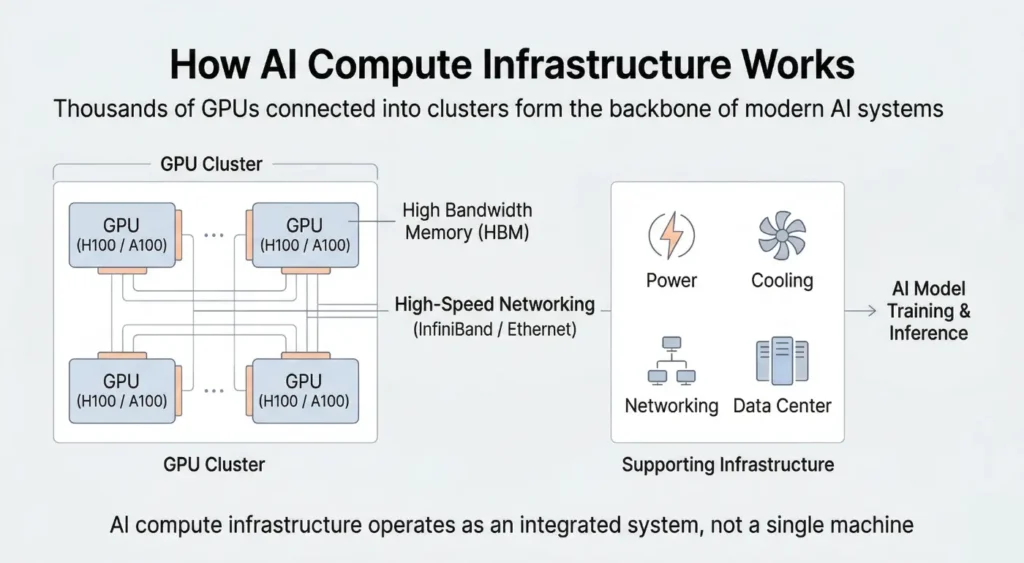
Effective AI compute infrastructure is built at the level of clusters, not individual machines. A single GPU is insufficient for frontier work; practical training requires thousands of GPUs networked into coherent systems. The networking fabric — whether InfiniBand or high-speed Ethernet — determines how efficiently these processors share data and synchronize their work. A slow network turns a large cluster into a collection of isolated chips.
Equally critical is memory bandwidth. GPUs can process data far faster than standard memory systems can supply it. High Bandwidth Memory (HBM), exists precisely to prevent processors from sitting idle waiting for data. The relationship between GPU compute and HBM memory is co-dependent: without sufficient memory bandwidth, additional processing capacity yields no additional throughput. This memory wall is one reason HBM has become the most constrained component in AI hardware supply chains.
Beyond the processors and memory, AI compute infrastructure includes the cooling systems required to manage heat generated at scale. Cooling represents roughly 40% of a data center’s energy use, per research from McKinsey and ScienceDirect. As power densities in AI server racks have more than doubled over the past six to seven years — reaching 20 to 30 kilowatts per rack in high-performance environments — traditional air-based cooling systems have struggled to keep pace. The industry is increasingly shifting toward liquid-based and AI-enhanced cooling architectures to bridge this efficiency gap.
The power infrastructure that supplies electricity to tens of thousands of processors running continuously completes the picture. Training a frontier AI model is the coordinated effort of a physical and logistical apparatus that more closely resembles industrial manufacturing than software development.
When Compute Became the Constraint
For most of artificial intelligence’s history as a discipline, the primary constraint was intellectual rather than computational. Researchers lacked good techniques for training deep neural networks, sufficient labeled data to feed them, and fast experimental cycles. Progress came in fits and starts, driven mainly by algorithmic breakthroughs—new training methods, architectural innovations, and theoretical insights.
That began to change around 2012, when it became clear that combining better hardware with larger datasets and deeper networks produced dramatic gains. The shift accelerated through the mid-2010s and became unmistakable by the early 2020s.
Training costs tell part of the story, but the full picture is more nuanced. A 2024 Statista report indicates that early large language models (LLMs) cost a few million dollars to train. Subsequent generations moved into the tens of millions, and by 2024, frontier training runs reached hundreds of millions of dollars. As discussed earlier, projections suggest next-generation frontier models could exceed $1 billion by 2027—though algorithmic efficiency is simultaneously reducing the compute required to achieve equivalent capability, creating a divergence between headline training runs and total development investment.
This divergence has structural consequences for who can participate in frontier AI. A research university might stretch to fund a multi-million-dollar compute budget for a final training run. Sustaining the experimental infrastructure, iterative testing, data pipelines, inference systems, and specialized teams required for frontier development—where total costs can reach hundreds of millions—is a different matter entirely. The compute constraint does not merely slow down under-resourced organizations; it limits who can afford the iterative experimentation that precedes any headline training run.
That said, exclusion from frontier training is not exclusion from the AI ecosystem. The proliferation of open-weight models has created alternative paths: fine-tuning existing models, building applications on top of APIs, and developing smaller specialized systems—often referred to as small language models (SMLs). These activities require far less capital than frontier training and represent where much of the industry’s practical innovation now occurs. The compute constraint shapes the field, but it does not monopolize it.
The AI Compute Supply Crunch: GPU Scarcity and Market Concentration
The situation is compounded by the structure of the hardware market itself. The supply of AI compute infrastructure is highly concentrated. A recent Investing.com analysis notes that Nvidia currently controls approximately 85% to 90% of the market for AI accelerators—the specialized chips, led by GPUs such as the H100 and H200, used to train and run large models.
This is not a position built on proprietary secrets alone, but on a decade-long accumulation of hardware capability, software ecosystem investment, and developer familiarity. Nvidia’s CUDA programming platform, which allows developers to write code that runs efficiently on Nvidia GPUs, has become so deeply embedded in AI research workflows that switching to an alternative accelerator involves substantial friction even when the alternative hardware is technically competitive.
The practical consequence of this concentration is limited flexibility in the supply chain. When demand for AI compute surged following the widespread adoption of large language models (LLMs), the market had essentially one primary source of supply at the chip level. Access to high-end GPUs became a strategic bottleneck, with organizations facing extended procurement cycles and prioritization based on scale and existing relationships.
Yet the supply landscape is evolving in multiple directions. First, a tier of specialized cloud providers—sometimes called NeoCloud operators—has emerged to offer GPU access outside the major hyperscalers. SemiAnalysis’s March 2025 GPU Cloud ClusterMAX rating system identifies the clear leaders in this crowded market: CoreWeave at Platinum tier, Crusoe and Nebius at Gold tier. These operators manage substantial fleets of Nvidia hardware, effectively serving as external capacity pools for organizations unable to secure direct allocations from hyperscalers or Nvidia itself.
Second, the largest technology companies have accelerated investment in custom silicon, moving from experimental projects to production-scale deployment. Google’s seventh-generation TPU, codenamed Ironwood, became generally available in November 2025 and scales to 9,216 liquid-cooled chips per pod with 1.77 petabytes of shared High Bandwidth Memory, scaling across pods into clusters of hundreds of thousands of TPUs.
Amazon, for its part, has reached comparable scale with its Trainium family. Anthropic’s Project Rainier, announced in April 2026, currently utilizes more than one million Trainium2 chips to train and serve Claude. The agreement commits Anthropic to more than $100 billion in AWS technologies over the next decade, securing up to 5 gigawatts (GW) of new capacity spanning Trainium2 through Trainium4. In December 2025, Amazon and Nvidia announced that Trainium4 will integrate with Nvidia’s NVLink Fusion platform, marking a multigenerational collaboration that combines custom silicon with industry-standard interconnect technology.
These alternatives do not yet challenge Nvidia’s market share at the frontier—about 6 million developers worldwide rely on Nvidia’s CUDA platform—but they are diversifying the architecture of AI compute infrastructure beyond a single vendor. Google’s push has attracted significant external interest: Reuters reported in November 2025 that Meta is in discussions to spend billions on Google TPUs for its data centers starting in 2027, a move that would mark Google’s entry as a direct chip supplier rather than solely an internal user. Some Google Cloud executives have suggested this strategy could capture as much as 10% of Nvidia’s annual revenue.
The bottleneck extends beyond the GPU itself. Specifically, High Bandwidth Memory, or HBM, is a specialized type of memory chip that sits alongside the GPU and feeds it data at the speeds necessary for training and inference. Its production is concentrated among a small number of manufacturers, and its supply has proven difficult to scale rapidly. HBM shortages directly constrain the availability of GPU-based AI compute.
The GPU and its memory are co-dependencies: even if Nvidia can produce enough of its core chips, the finished product cannot ship without sufficient HBM to pair with them. This creates a second layer of supply constraint that further limits the pace at which organizations can expand their AI compute capacity—a dynamic explored in detail in the discussion of HBM Valuable AI Hardware Component.
The Economics of AI Compute: Capital Barriers and Cloud Alternatives
The cost structure of AI compute infrastructure helps explain why the field has consolidated around a small number of well-capitalized actors. High-end GPUs such as Nvidia’s H100 represent the core unit of AI compute. A single H100 GPU carries a list price starting at approximately $25,000, with multi-GPU configurations and market conditions pushing system costs significantly higher. That figure already positions AI hardware as a significant capital expense, but it understates the actual cost of doing meaningful work.
Training frontier models requires not one GPU but thousands operating in parallel. A practical AI training cluster might involve eight GPUs housed in a single server, but a serious training run requires thousands of such servers networked together into a larger system. Meta’s Llama 3 405B model, for example, was trained on more than 16,000 H100 GPUs operating as a single coordinated cluster. The cost of a multi-GPU training system, including the necessary networking and supporting hardware, typically runs between $200,000 and $500,000 or more, depending on scale and configuration.
The hardware is only part of the picture. Epoch AI modeling from May 2026 indicates that servers account for approximately 60% of the total cost of ownership in a large-scale data center, with power, cooling, real estate, networking infrastructure, and operations staff comprising the remainder. Over a typical equipment lifespan, these operational costs multiply the initial hardware investment several-fold.
Organizations that do not want to own the hardware outright can rent access to cloud-based compute from major providers. Cloud pricing for high-end GPU instances varies by provider and commitment level; hourly rates for Nvidia H100 instances range from approximately $2.50 to nearly $10, with longer-term agreements and committed-use discounts reducing effective rates substantially.
The following table summarizes hourly pricing for Nvidia H100 GPU instances across select cloud providers, based on data from Jarvis Labs. These figures reflect market conditions at the time of analysis and are subject to change based on demand, availability, and provider pricing adjustments.
| Provider | Price per hour | Commitment required | Best for | Key features |
|---|---|---|---|---|
| Jarvis Labs | $2.69 | None (per-minute billing) | Flexible workloads, experimentation | 90-second startup, India & Europe regions, managed JupyterLab/VS Code |
| Lambda Labs | $2.99 | None | Researchers, educational use | Simple interface, popular in academia |
| Modal | $4.56 | None | Serverless AI applications | Auto-scaling, container-first approach |
| RunPod | $2.99 | None | Community-driven projects | GPU marketplace, competitive spot pricing |
| Baseten | $9.984 | None | Enterprise ML deployment | Managed inference, production-ready infrastructure |
That range sounds modest until one considers that a serious training run might involve tens of thousands of GPUs running continuously for several weeks. The arithmetic quickly produces costs in the millions or tens of millions of dollars for a single training experiment—and frontier organizations do not run one experiment; they run many, iterating on architecture, data, and training procedures.
The economic picture extends beyond training. Inference typically constitutes the dominant share of an AI model’s operational compute consumption. While individual inference queries carry incremental costs in energy and processing time, serving millions or billions of queries daily creates an operational expenditure that accumulates rapidly. This shifts the financial challenge from one-time capital investment to continuous operational scaling, with inference costs potentially exceeding training expenditure within months of deployment at scale.
Cloud providers have recognized this capital barrier and responded with structured programs to reduce friction for emerging AI companies. For example, in 2024, AWS has pledged $230 million for generative-AI startups, with individual grants up to $100,000 and accelerator participants eligible for as much as $500,000. Similarly, Azure provides up to $150,000 in credits, while Google Cloud makes up to $350,000 available over two years. These incentives lower immediate barriers to entry, though they typically convert to standard pricing once exhausted and require technical integration that can deepen reliance on a single platform.
This capital intensity has meaningful implications for who participates in the field. Software development, historically, has required relatively modest capital investment. A skilled engineer with a laptop and internet access can build and deploy significant products. AI development at the frontier looks nothing like this. The compute costs alone create a financial barrier that is simply absent in most other areas of technology.
Organizations without access to substantial capital—or without relationships with cloud providers offering credit programs and preferential pricing—are structurally disadvantaged before a single line of model code is written. AI compute is not only expensive to acquire, but expensive to operate continuously at scale.
Strategic Control Through AI Compute Infrastructure
Recognizing this dynamic, the hyperscalers have moved aggressively to secure control over AI compute infrastructure. The scale of this commitment is reflected in capital planning: the above analysis from Investing.com notes that the four largest hyperscalers—Microsoft, Google, Amazon, and Meta—have collectively guided approximately $700 billion in 2026 capital expenditures, with AI infrastructure representing a significant share. These figures reflect a strategic calculation that controlling the physical infrastructure of artificial intelligence is as important as developing the models that run on it.
A company that controls large-scale AI compute infrastructure can train its own models, offer compute access to customers and partners, and shape the practical conditions under which AI development happens. The relationships between compute providers and AI developers are not merely transactional. Microsoft’s partnership with OpenAI exemplifies this evolution: since 2019, Microsoft has invested in OpenAI’s development, and as of October 2025 holds an investment valued at approximately $135 billion, representing roughly 27 percent on a fully diluted basis.
The agreement preserves Azure’s exclusivity as OpenAI’s frontier model API provider until the achievement of artificial general intelligence, while also allowing OpenAI to diversify its infrastructure relationships. OpenAI’s Stargate initiative, announced in January 2025, illustrates this diversification: a new company backed by SoftBank, Oracle, and the UAE’s MGX intends to invest $500 billion over four years in U.S. AI infrastructure, with $100 billion in immediate deployment and technology partnerships including NVIDIA, Oracle, and Microsoft.
Custom silicon is another dimension of this competition. As noted in the discussion of supply constraints, Google, Amazon, and Microsoft have moved from experimental projects to production-scale deployment of proprietary chips. The motivation is partly economic: proprietary chips can be cheaper to deploy at scale than purchased alternatives. But it is also strategic. Dependence on a single external supplier for a critical input is a vulnerability, and organizations operating at the frontier of AI development have strong incentives to reduce that exposure. The development of custom AI silicon is, in this sense, as much an infrastructure strategy as a hardware engineering project.
The competition for control extends beyond individual companies. National governments and sovereign wealth funds are increasingly treating AI compute as strategic infrastructure. In October 2025, a consortium led by MGX—Abu Dhabi’s dedicated AI investment vehicle—closed a $40 billion acquisition of Aligned Data Centers, representing over 5 GW of capacity across 50 facilities, while Saudi Arabia’s PIF-backed HUMAIN initiative secured $1.2 billion in financing in January 2026 for large-scale compute facilities.
The European Union, for its part, is pursuing parallel investment in sovereign capacity. According to a recent report from Gartner, the continent is building collaborative sovereign cloud infrastructure projected to exceed $23 billion in spending by 2027. The underlying logic across these diverse initiatives is consistent: AI compute capacity is increasingly understood not merely as a commercial asset, but as a determinant of economic competitiveness and technological autonomy.
Structural Consequences of AI Compute Concentration for the Industry
The concentration of AI compute infrastructure in the hands of a small number of hyperscalers means that those without access to large-scale compute are structurally limited. It shapes what kinds of AI systems get built, by whom, and under what conditions.
The barrier to entry for training frontier models has risen to the point where it is effectively prohibitive for most organizations. Academic researchers, startups without major backing, and companies in smaller markets increasingly find themselves unable to train state-of-the-art models independently. They can fine-tune existing models, build applications on top of APIs, or work with smaller-scale architectures—activities that have become the primary locus of practical innovation and deployment, even if they are distinct from the frontier development that shapes the field’s direction.
The organizations doing frontier training work remain a small, capital-concentrated set, with the largest investments historically concentrated in the United States. However, the competitive landscape has shifted: as of March 2026, LMSYS Arena rankings show Chinese laboratories such as Alibaba and DeepSeek competing directly alongside Anthropic, xAI, Google, and OpenAI in the top tier of model performance, with the U.S.-China performance gap effectively closed to within single-digit percentage points.
This concentration is not merely a competitive fact. It raises longer-term questions about the diversity of approaches being pursued, the resilience of the field to disruption, and the extent to which AI development reflects a broad range of perspectives and priorities. When the infrastructure required to do frontier work is controlled by a handful of entities, those entities have significant influence—intentional or otherwise—over what kinds of systems get built and what values and priorities are embedded in them.
Policy responses are already emerging. United States export controls on advanced AI chips to China, maintained and updated through 2025, restrict the sale of frontier computing hardware, semiconductor manufacturing equipment, and AI software. The European Union has proposed the Cloud and AI Development Act, which aims to accelerate data center construction and standardize requirements for EU-based high-performance computing, with an indicative target timeline of late 2027. These measures reflect recognition that control over AI compute carries strategic implications beyond commercial competition.
Geographic diversification of frontier capability is also underway. French’s Mistral AI launched Forge in March 2026, a platform enabling enterprises to execute full model training lifecycles—including pre-training, post-training, and mixture-of-experts architectures—on proprietary data, with early adoption spanning industrial and defense sectors across the EU and Asia-Pacific.
In the middle east, the Gulf states are collectively planning 8 to 10 GW of computational capacity, leveraging sovereign wealth capital and abundant energy resources to position themselves as the largest compute buildup outside the United States and China. This expansion suggests that while capital concentration persists, the geographic locus of frontier AI infrastructure is becoming more distributed than the current generation of training leadership implies.
There is also a feedback dynamic at work, though it operates in tension with the efficiency gains discussed earlier. Organizations with more compute can run more experiments, iterate faster, and maintain larger research teams. More experiments produce more learning, which informs better models and more efficient training methods.
Those improvements, in turn, require more compute to fully exploit at the frontier. Algorithmic progress—estimated at roughly 3x efficiency improvement per year for pre-training—partially offsets this dynamic by reducing the compute needed to achieve a given capability level. But at the frontier, where the objective is not to match past performance but to exceed it, the net effect remains reinforcing: the organizations already ahead in compute access tend to benefit disproportionately from advances in how to use compute effectively, extending their position rather than eroding it.
The Infrastructure Era of AI
The framing that dominated early discussions of artificial intelligence—that the field would advance primarily through mathematical insight and algorithmic discovery—has not been proven wrong, but it has been substantially complicated. Algorithmic progress remains essential. The architectural choices made in designing a model, the methods used to train it, and the data it learns from all matter enormously. But these factors now operate within a constraint that was largely absent for most of the discipline’s history: the availability and cost of the physical infrastructure required to run the work.
AI development at the frontier increasingly depends on access to AI compute infrastructure. The organizations best positioned to advance the field are those with the capital to build or procure compute at scale, the relationships to secure hardware supply in a constrained market, and the operational expertise to run large-scale training and inference workloads efficiently. These are not primarily research capabilities. They are industrial, financial, and operational capabilities, more closely related to the competencies of a large technology company or cloud provider than to those of a research institution.
This does not diminish the importance of the research itself. Genuine algorithmic improvements—better training methods, more efficient architectures, techniques that achieve more with less compute—remain highly valuable precisely because they extend what can be done within a given compute budget. But those improvements happen on top of, and in competition with, the fundamental constraint that more compute generally produces better results. Until that relationship changes in some significant way, the institutions that control AI infrastructure will retain a structural advantage that no algorithm alone can overcome.
The story of AI’s next chapter is being written not only in the equations of researchers but in the procurement decisions of finance departments, the capacity planning of data center operators, and the supply chains of chip manufacturers. Compute has become the terrain on which AI progress is fought—more precisely, AI compute determines who can build, scale, and compete. As compute expands, other parts of the system—particularly memory and power—become the next limiting factors.
This article is being provided for educational purposes only. The information contained in this article does not constitute a recommendation from Intellaix to the recipient, and Intellaix is not providing any financial, economic, legal, investment, accounting, or tax advice through this article or to its recipient.
Sources and references:
- Epoch AI, May 2024. “Training compute of frontier AI models grows by 4-5x per year”
- Omdia, April 2026.”Frontier AI model growth slows as “small” models scale up and reshape infrastructure demand”
- arXiv, February 2025. “The rising costs of training frontier AI models”
- SemiAnalysis, January 2025. “DeepSeek Debates: Chinese Leadership On Cost, True Training Cost, Closed Model Margin Impacts”
- Epoch AI, September 2025. “Why GPT-5 used less training compute than GPT-4.5 (but GPT-6 probably won’t)”
- Epoch AI, February 2026. “Trends in Artificial Intelligence”
- Google Cloud. “What is AI inference?”
- IBM Technology, November 2024. “AI Inference: The Secret to AI’s Superpowers”
- McKinsey & Company, February 2026. “The future of AI workloads”
- McKinsey & Company, January 2023. “Investing in the rising data center economy”
- ScienceDirect, 2025. “AI-driven cooling technologies for high-performance data centres: state-of-the-art review and future directions”
- Statista, September 2024. “The Extreme Cost of Training AI Models”
- Investing.com, April 2026. “Nvidia AI Spending Tailwind Still Points to Higher Revenue Estimates”
- Nvidia. “CUDA Programming Guide”
- SemiAnalysis, March 2025. “The GPU Cloud ClusterMAX™ Rating System | How to Rent GPUs”
- Google Cloud, November 2025. “Announcing Ironwood TPUs General Availability and new Axion VMs to power the age of inference”
- Anthropic, April 2026. “Anthropic and Amazon expand collaboration for up to 5 gigawatts of new compute”
- Nvidia, December 2025. “AWS Integrates AI Infrastructure with NVIDIA NVLink Fusion for Trainium4 Deployment”
- Nvidia, March 2026. “CUDA is NVIDIA’s platform for accelerated computing and the foundation for GPU computing”
- Reuters, November 2025. “Meta in talks to spend billions on Google’s chips, The Information reports”
- Jarvis Labs, March 2026. “NVIDIA H100 Price Guide 2026: GPU Costs, Cloud Pricing & Buy vs Rent”
- Meta, July 2024. “Introducing Llama 3.1: Our most capable models to date”
- Epoch AI, May 2026. “Servers account for 60% of the total cost of ownership of a one-gigawatt AI data center”
- Amazon News, June 2024. “AWS Announces $230 Million Commitment for Generative AI Startups”
- AWS Amazon. “Build your startup on AWS”
- Google Cloud. “Startup AI”
- Microsoft, October 2025. “The next chapter of the Microsoft–OpenAI partnership”
- OpenAI, January 2025. “Announcing The Stargate Project”
- Forbes, December 2025. “UAE 2026: What Abu Dhabi’s $1.7 Trillion Is Actually Buying”
- Reuters, January 2026. “Saudi’s Humain secures up to $1.2 bln to expand AI infrastructure”
- Gartner, February 2026. “Gartner Says Worldwide Sovereign Cloud IaaS Spending Will Total $80 Billion in 2026”
- HAI Stanford. “2026 AI index report”
- Congress.gov, September 2025. “U.S. Export Controls and China: Advanced Semiconductors”
- European Union Cloud. “EU Cloud and AI Development Act | Updates, Compliance“
- Futurum Group, March 2026. “Mistral Forge Takes Aim at RAG. But Who Actually Needs Custom Models?”
- Middle East Institute, May 2026. “The Impact of the Iran War on the Gulf’s Grand AI Plans”
