


Artificial intelligence is often described as a breakthrough in software, algorithms, and data. But what is happening behind the scenes tells a different story. The systems that power today’s most capable AI models increasingly resemble power plants and railroads more than traditional applications.
Artificial intelligence now depends on specialized chips, vast compute clusters, dense data centers, and growing portions of national electricity grids—all backed by unprecedented capital spending. For example, the four largest hyperscalers (Microsoft, Alphabet, Meta, and Amazon) are projected to invest up to $725 billion in 2026, most of it dedicated to AI infrastructure including data centers, chips, and networking equipment. As this stack scales, AI is evolving from a fast-moving software story into a full-fledged AI infrastructure industry.
AI systems do not scale uniformly. They depend on multiple interdependent components—compute, memory, networking, and power—each of which can become a limiting factor. As one constraint is addressed, another emerges. This shifting set of bottlenecks is what increasingly defines the trajectory of AI infrastructure development.
The Compute Foundations of Modern AI Models
Modern AI models, particularly large language models (LLMs) and multimodal systems, are trained on clusters containing thousands or tens of thousands of accelerators working in parallel. The pretraining of Meta’s Llama 3 405B, for example, occupied approximately 16,000 H100 GPUs for 54 days on a production cluster. This means that instead of running on a few servers, today’s models run on massive, tightly coordinated machines.
These training clusters are no longer simple server rooms. They are highly engineered compute fabrics designed to move data quickly and continuously, keeping expensive hardware fully utilized. GPUs (graphics processing units, specialized chips designed for parallel math operations) and other accelerators like TPUs and custom ASICs, sit at the center of this design. Their importance lies in their ability to perform the matrix calculations required for deep learning far more efficiently than general-purpose CPUs.
Training frontier models requires both scale and density. This means racks filled with accelerators, high-speed networking between nodes, and orchestration software (tools that coordinate workloads and handle failures automatically) managing the entire system.
Power demand can fluctuate by 30–60% within milliseconds during training, according to a 2025 McKinsey research. That is equivalent to turning thousands of homes on and off almost instantly. Because of this, power delivery and cooling must be designed for resilience and fault tolerance.
As a result, compute infrastructure is increasingly constrained by how much specialized hardware, power delivery, and cooling can be built with resilient, fault-tolerant design.
Core Components of AI Infrastructure
The core layers of AI infrastructure work together like parts of an industrial system:
- Compute accelerators (GPUs/TPUs): perform deep learning calculations
- High-bandwidth memory (HBM, ultra-fast memory that feeds data to chips): keeps data flowing at high speed
- Networking: connects thousands of machines into one system
- Data centers: house the infrastructure
- Energy and cooling: keep systems powered and stable
Memory and Semiconductor Constraints in AI Infrastructure
If accelerators are the engines of artificial intelligence, high-bandwidth memory (HBM) is the fuel line that keeps them running efficiently. Even the fastest chips slow down if they cannot get data quickly enough.
Modern AI workloads move huge volumes of data between memory and compute. Without sufficient bandwidth, even advanced GPUs sit idle waiting for data. This is why HBM capacity and bandwidth have become critical bottlenecks: they determine how large an AI model can be, how fast it can train, and how efficiently inference can run at scale.
These constraints exist within a broader semiconductor supply chain that is highly concentrated and capital-intensive. Advanced AI hardware infrastructure relies on leading-edge manufacturing nodes, sophisticated packaging, and specialist memory technologies that only a handful of fabs worldwide can produce.
When demand for accelerators increases, shortages ripple across the system—from GPUs to memory to networking components. Artificial intelligence progress is therefore tied directly to industrial-scale chip infrastructure: fabrication plants (fabs), advanced packaging facilities, and global logistics networks that connect them.
In practical terms, building better AI is not just about better models—it also depends on how fast the semiconductor industry can expand capacity and deliver reliable, high-bandwidth components.
Expanding that capacity requires capital investment on a scale now measured in the hundreds of billions of dollars annually, which is why the next phase of AI development is increasingly shaped by the financial resources of hyperscalers and large technology firms.
The Capital Behind AI Infrastructure
Building AI infrastructure is extremely expensive. Only a few companies in the world can afford to operate at the cutting edge. Hyperscalers like Microsoft, Alphabet, Meta, and Amazon are committing capital expenditure at a scale that rivals heavy industry.
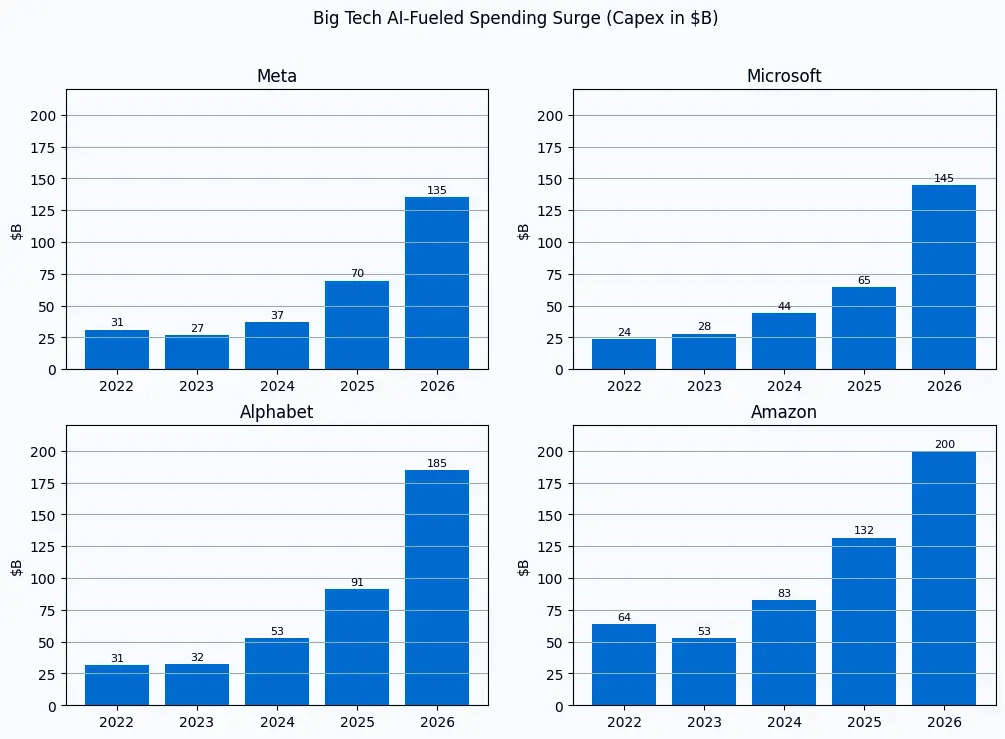
Source: Companies reports
On the physical side, data centers are multi-billion-dollar projects. The Stargate project—a $500 billion collaboration between OpenAI, Oracle, and SoftBank—illustrates the industrial scale of AI infrastructure deployment. Seven sites across the US are now in active development, with the most advanced facility in Abilene, Texas already operating at an estimated 0.3 gigawatts. Combined planned capacity exceeds 9 gigawatts, comparable to the peak power demand of New York City.
Companies are also raising large funding rounds just to secure access to compute clusters. Investors increasingly treat AI infrastructure as a long-term asset class, similar to energy or transportation infrastructure.
The key idea: the economics of artificial intelligence are now deeply tied to large-scale, long-lived capital investments.
Competition for AI Compute
As AI systems become more infrastructure-intensive, access to compute is becoming a primary driver of competition. The race is no longer just about who builds the best model—but who controls the most powerful machines.
Market analysis from Goldman Sachs reinforces this shift: after the initial dominance of chipmakers like Nvidia, investment is now expanding toward infrastructure providers and the systems that enable artificial intelligence at scale. Some analysts describe this shift as the ‘second phase’ of the AI boom—where infrastructure, not just models, becomes the central battleground.
Hyperscalers now compete not only on software services but on who can deliver the most capable, cost-effective compute clusters. This includes designing custom AI chips, integrating them with in-house networking and storage, and offering them through cloud platforms that bundle hardware, frameworks, and managed services.
Partnerships between AI labs and cloud providers reflect this shift. Leading labs enter multi-year agreements that trade strategic alignment and exclusivity for guaranteed access to large compute clusters and integration into cloud ecosystems.
For smaller firms and startups, the question is less “Can we build a better model?” and more “Can we secure enough reliable, affordable compute to compete?”. Success depends not only on innovation, but also on access to compute resources.
Custom silicon, converged system architectures, and tightly integrated software stacks have become strategic tools, not just technical details. The emerging AI infrastructure industry is therefore organized around control of scarce inputs: GPUs, memory, power, and the facilities that tie them together.
Energy and the Emerging Power Wall in Artificial Intelligence
As AI compute grows, electricity becomes a major constraint. The future of artificial intelligence depends on energy availability as much as software.
AI workloads are turning data centers into one of the fastest-growing sources of power demand. According to the same McKinsey research cited above, AI is now the primary growth engine for US data centers, with power demand projected to grow from approximately 30 gigawatts in 2025 to 90 or more gigawatts by 2030—a compound annual growth rate of roughly 22 percent. That projected 2030 capacity exceeds the entire current power demand of California.
More broadly, McKinsey’s Power Model projects US power demand rising from around 5,000 terawatt-hours by 2030 to roughly 7,000 terawatt-hours by 2040 under current trajectory scenarios, with data centers among the fastest-growing segments. In this context, every additional 1,000 TWh of generation is equivalent to the entire current electricity consumption of Japan, the fourth largest economy in the world.
U.S. data centers consumed approximately 176 terawatt-hours in 2023—roughly 4.4% of national electricity use. The Congressional Research Service notes that consumption could double or triple by 2028, driven in part by artificial intelligence workloads.
Much of the new baseload is expected to come from natural gas and nuclear generation, provided there is sufficient investment in pipelines, turbines, enrichment, and advanced reactors.
Inside data centers, energy efficiency is becoming a design priority: server density is pushing air cooling to its limits, forcing a shift to liquid and immersion cooling to manage heat effectively. In this environment, data center power consumption is no longer just an operating cost; it is a strategic variable that determines where AI facilities can be built, how fast they can expand, and which firms can keep scaling when local grids hit their limits.
As a result, data-center construction is increasingly driven by regional electricity availability, pushing new facilities toward areas with abundant energy and sufficient grid capacity; storing and processing more data requires correspondingly more power.
Generative AI as Infrastructure for Work
While the physical layer of artificial intelligence looks more like traditional infrastructure, the applications layer is quietly becoming part of everyday workflows. Generative AI adoption is still in its early stages—Pew Research Center data from June 2025 shows that 34% of US adults had used ChatGPT, roughly double the 2023 level. The figure remains modest, suggesting that widespread adoption has not kept pace with infrastructure expansion. Coding assistants, AI research tools, and enterprise AI platforms are moving from experiments into standard tools embedded in software development, knowledge work, and operations.
In this sense, generative AI is turning into a form of “intelligence infrastructure” delivered through cloud platforms. Instead of every organization training its own large models, they plug into shared compute clusters via APIs, fine-tune or configure models for their own use cases, and integrate them into existing productivity systems.
This is the commoditization of intelligence: capabilities like summarization, translation, forecasting, and content generation become widely available as on-demand services. The value shifts from owning the core model to orchestrating how it is used, integrated, and governed across workflows. AI infrastructure in the background—GPUs, memory, networks, and power systems—enables this broad, utility-like access.
In many organizations, generative AI is already embedded in daily workflows. Software engineers rely on coding assistants to generate and review code, analysts use AI tools to summarize documents and extract insights from large datasets, and customer-service platforms integrate models to automate responses. As these systems integrate into enterprise software, generative AI begins to function less like a standalone tool and more like an underlying layer of digital infrastructure.
Four Drivers Behind AI Infrastructure
Several forces explain why AI is turning into an infrastructure industry rather than remaining a pure software domain.
1. Fundamental industrial shift
Progress now depends on physical systems and industrial-scale computing infrastructure. Artificial intelligence is anchored in data centers, energy systems, semiconductor fabs, and global supply chains that must deliver ever more powerful compute clusters at acceptable cost. The shift from commodity cloud servers to purpose-built data centers shows how deeply hardware and facilities are being re-engineered around AI workloads.
2. Operational productivity and optimization
AI is also a tool for improving infrastructure itself. Artificial intelligence can process large datasets, reveal patterns, predict failures, and optimize resources across planning, construction, and operations. Morgan Stanley research from March 2026 indicates that AI adopters are seeing measurable efficiency gains, with cash-flow margin expansion outpacing the global average by twofold. These gains extend beyond technology firms to second-order beneficiaries, suggesting that infrastructure and industrial sectors are beginning to capture value from AI-driven optimization.
3. Predictive capabilities
Across sectors, artificial intelligence now provides forecasting and decision support that traditional tools cannot match. In infrastructure use cases, predictive maintenance and digital twins help operators anticipate failures and optimize asset performance over time. In broader enterprise settings, AI models support forecasting in finance, energy, and supply chains. These predictive capabilities depend on both data and compute: the more accurate and timely the forecasts, the more they reinforce demand for robust compute and storage infrastructure.
4. Commoditization of intelligence
Finally, artificial intelligence itself is being delivered as a scalable service. Cloud platforms increasingly package models, tooling, and infrastructure into offerings that organizations can adopt without managing hardware directly. As generative AI adoption grows, it behaves more like a shared utility: accessed through APIs, priced based on usage, and integrated into a wide range of applications. This is structurally similar to other infrastructure industries, where the underlying assets are concentrated but the services built on top are distributed and diverse.
From Software Story to AI Infrastructure Industry
Taken together, these developments signal a decisive shift. Artificial intelligence is no longer just a rapid software innovation cycle driven by clever algorithms and new applications. It is becoming a large-scale infrastructure industry shaped by compute capacity, semiconductor manufacturing, energy supply, capital investment, and global hardware systems.
Frontier models depend on massive compute clusters; those clusters require dense hardware infrastructure with high-bandwidth memory, advanced cooling, and reliable power; the build-out of this stack demands sustained capital expenditure and long-term planning.
As generative AI adoption spreads through coding assistants, research tools, and enterprise platforms, the intelligence it provides increasingly resembles a shared utility delivered through data centers and cloud platforms rather than standalone software products.
In this new phase, strategic advantage will accrue to those who can design, fund, and operate the most efficient, scalable, and energy-aware AI infrastructure. The future of artificial intelligence will be written not only in code, but in concrete, copper, silicon, and steel.
This article is the first in a series examining AI’s infrastructure transformation. Future pieces will explore the semiconductor supply chain, energy constraints, and the emerging geography of AI compute.
This article is being provided for educational purposes only. The information contained in this article does not constitute a recommendation from Intellaix to the recipient, and Intellaix is not providing any financial, economic, legal, investment, accounting, or tax advice through this article or to its recipient.
Sources and references:
- Statista, April 29, 2026. “Big Tech’s AI Spending to Reach $725 Billion in 2026.” Company reports.
- arXiv, July 2024. “Challenges and Opportunities in LLM Training Infrastructure.
- arXiv, May 2026. “TrainMover: An Interruption-Resilient Runtime for ML Training”
- McKinsey & Company, December 2025. “The next big shifts in AI workloads and hyperscaler strategies.”
- Epoch AI, April 2026. “OpenAI Stargate: Where the US Sites Stand.”
- Goldman Sachs, April 2024. “AI infrastructure stocks are poised to be the next phase of investment”
- McKinsey & Company, April 2026. “Powering a new era of US energy demand”
- Congress, May 2026. “Data Centers and Their Energy Consumption: Frequently Asked Questions”
- Pew Research Center, June 2025. “34% of U.S. adults have used ChatGPT, about double the share in 2023”
- Morgan Stanly, March 2026. “AI Is Now a Macro Variable. Are You Positioned?”
