


There is a deceptively simple question at the center of modern AI: When you deploy an AI capability, what is actually the product? Is it the trained model itself—its weights, its learned representations, its frozen intelligence? Or is it the system surrounding it: the data pipelines feeding it, the orchestration layer directing it, the APIs exposing it, the safety filters constraining it, and the infrastructure sustaining it at scale? At small scale, the distinction is easy to ignore. At system scale—when platforms process billions of requests per day—it becomes unavoidable.
For most of artificial intelligence’s research history, the answer was unambiguous: the AI model was the product. The field’s intellectual output was measured in benchmark performance, parameter counts, and architectural novelty. Deploying a model was almost an afterthought—a demonstration step that confirmed the research result. But as AI has crossed from laboratory to production, as foundation models now serve billions of requests per day—according to a 2025 Axios report citing internal OpenAI figures, ChatGPT processes on the order of 2.5 billion prompts daily.—and inference costs dwarf training budgets at scale, the answer has become far more complicated—and far more consequential.
This article argues that AI models are not disappearing as meaningful entities. The model remains the irreducible core of intelligence; it defines the upper bound of what any system built around it can accomplish. But increasingly, especially in large-scale production contexts, the model functions as a component inside a continuously operating system rather than as a standalone product.
Understanding when this shift applies—and why it is economically and architecturally inevitable for certain classes of deployment—is now a foundational concern for anyone building or evaluating AI infrastructure.
Defining the AI Model and AI System: A Conceptual Foundation
Before engaging with the architecture and economics of this shift, it is worth grounding the discussion in emerging definitional work. A recent arXiv preprint—”Defining AI Models and AI Systems”—attempts to resolve this confusion systematically. The authors, drawing on nearly 900 academic papers and 80+ regulatory documents, propose a distinction that is useful for our purposes: an AI model is the trainable artifact (weights, architecture, training data), while an AI system is the deployable capability that includes the model plus its operational context (infrastructure, interfaces, guardrails, and update mechanisms).
This is not merely academic taxonomy. If a model produces harmful output, the failure might lie in the weights—or in the prompt template, the retrieval corpus, or the safety filter that was supposed to catch it. The preprint’s framework suggests we should assign accountability to the system, not just the model, because only the system is fully observable at deployment time.
This distinction reshapes how we think about what is being built, bought, and optimized. If the model is only one component of a deployable system, then evaluating artificial intelligence by benchmark scores alone—treating the model as the complete product—systematically misleads us about production capability, cost structure, and risk exposure. The model defines what is theoretically possible; the system determines what is actually delivered, at what cost, and with what safeguards. That is the shift this article examines.
We use that distinction as the conceptual backbone of this article. But we should note the paper’s status: it is a preprint, not yet peer-reviewed, and its specific regulatory recommendations—particularly around liability assignment—remain contested in the policy literature.
With that distinction in place, the question becomes operational: how does this difference manifest in real-world systems?
The Engine and the Car—and Why the Analogy Has Limits
The AI model-as-engine, AI system-as-car analogy is frequently invoked to explain this distinction, and it is genuinely useful as a first approximation. An engine determines the fundamental performance envelope of a vehicle—its power, efficiency ceiling, and mechanical character. But no one sells an engine to a commuter.
The commuter purchases a car: a complex integration of drivetrain, chassis, electronics, safety systems, and user interface, all engineered to work together. Similarly, a foundation model determines the ceiling of AI capability for any given task. But few production deployments expose raw model inference to end users without substantial surrounding infrastructure.
The analogy, however, breaks down at a critical point: engines are static once manufactured. AI models are increasingly not. Continuous fine-tuning, reinforcement learning from human feedback collected in production, prompt routing based on request classification, and retrieval-augmented generation that injects dynamic knowledge into inference—these make the boundary between AI model and AI system genuinely porous in ways that have no automotive equivalent.
In a mature artificial intelligence deployment, the model is not a fixed engine; it is closer to a living component whose effective behavior is partially determined by the system orchestrating it. This porosity is one of the strongest arguments for treating the AI system, not the AI model alone, as the primary unit of analysis in production artificial intelligence.
This distinction is not just conceptual. It is reflected directly in how AI systems are built and paid for.
The Economic Inversion: From Training to Inference
For most of the deep learning era, training was the dominant cost center. Building GPT-3, for instance, required compute resources estimated in the single- to low-tens of millions of dollars—a one-time capital event that produced a deployable artifact. Inference, by comparison, seemed cheap: a forward pass is computationally lighter than a backward pass, and early deployment scales were modest enough that operational costs were secondary.
That calculus has inverted. A 2025 Deloitte analysis projects that by 2026, inference workloads will account for roughly two-thirds of total AI compute, reflecting a structural shift from building models to operating them continuously. Deloitte predicts that a majority of computations will still run on cutting-edge chips inside large data centers valued at $400 billion or more—meaning hyperscaler infrastructure investment is not decelerating. At scale, the economics change. When an AI model serves hundreds of millions of users, cost is no longer driven by training. It is driven by inference volume.
The economics here are shaped by two simultaneous forces. First, the unit cost of inference has collapsed: Stanford’s 2025 AI Index Report finds that the cost to reach a fixed performance threshold—equivalent to GPT‑3.5’s MMLU score—fell from $20 per million tokens in November 2022 to $0.07 per million tokens by October 2024 (achieved in part by models such as Google’s Gemini‑1.5‑Flash‑8B), a roughly 280× reduction over about 18 months. For any fixed workload, this represents genuine savings.
Second, demand has expanded faster than prices have fallen—a textbook Jevons effect. Lower costs unlock new use cases, larger context windows, and higher request volumes, so total inference spending rises even as each individual call becomes cheaper. The net result is not that price drops are economically nullified, but that AI’s addressable market is expanding faster than its unit economics are improving.
Optimizing inference is not simply a matter of running a faster GPU. It involves request batching strategies, speculative decoding, key-value cache management, dynamic quantization, load-aware model routing between full-precision and distilled variants, and hardware-software co-design at the cluster level. None of these are properties of the model itself; they are properties of the inference infrastructure surrounding it. This means that two organizations deploying the same foundation model can achieve dramatically different cost and latency profiles depending entirely on their systems engineering. The model is necessary but it is no longer sufficient as a competitive differentiator at this operational layer.
The Architecture of Modern AI Deployment
What does the surrounding system actually look like? Mature AI deployments have converged on a recognizable multi-layered architecture, even if the specific components vary by provider and use case.
At the infrastructure layer sit the compute clusters, distributed storage, and networking fabric that move tensors between memory and processing units at scale. This layer is increasingly specialized. NVIDIA’s Blackwell architecture exemplifies the shift: the GB200 NVL72 system orchestrates 72 GPUs as a single unified inference domain via NVLink and NVSwitch, with second-generation Transformer Engine enabling FP4 precision and TensorRT-LLM software optimizing kernel execution.
For agentic workloads specifically, the Nvidia GB300 NVL72 system—featuring the Blackwell Ultra GPU—achieves up to 50x higher throughput per megawatt and 35x lower cost per token compared with the Nvidia H100/H200 Hopper platform—but only when combined with disaggregated serving, which splits inference into distinct prefill and decode phases routed to specialized hardware pools. The Nvidia B200 software optimizations achieved two cents per million tokens on gpt-oss, demonstrating that 5x lower cost per token can be delivered in just two months through continuous software refinement.
These gains are not properties of the GPU chip alone; they require hardware-software co-design at the cluster level. The economics here are significant—capital expenditure on AI infrastructure is accelerating across every major cloud provider, and the ROI depends on sustaining high utilization of expensive hardware through effective orchestration.
Above the infrastructure layer sits the orchestration layer: the logic that decides which model handles which request, how context is assembled, how tool calls are sequenced in agentic workflows, and how outputs are validated before being returned. This is where retrieval-augmented generation systems connect the model to live knowledge bases, where multi-agent pipelines coordinate specialized sub-models, and where memory systems maintain conversational or task state across sessions. The orchestration layer is the fastest-evolving component of AI systems architecture, and it is where much of the current engineering investment is concentrated.
At the top sits the interface and safety layer. Here, models are wrapped in moderation systems, output filters, prompt management frameworks, and API contracts that define what external developers can access and how. This layer enforces behavioral constraints that the model itself cannot guarantee—a sufficiently capable model does not produce only safe outputs without architectural guardrails.
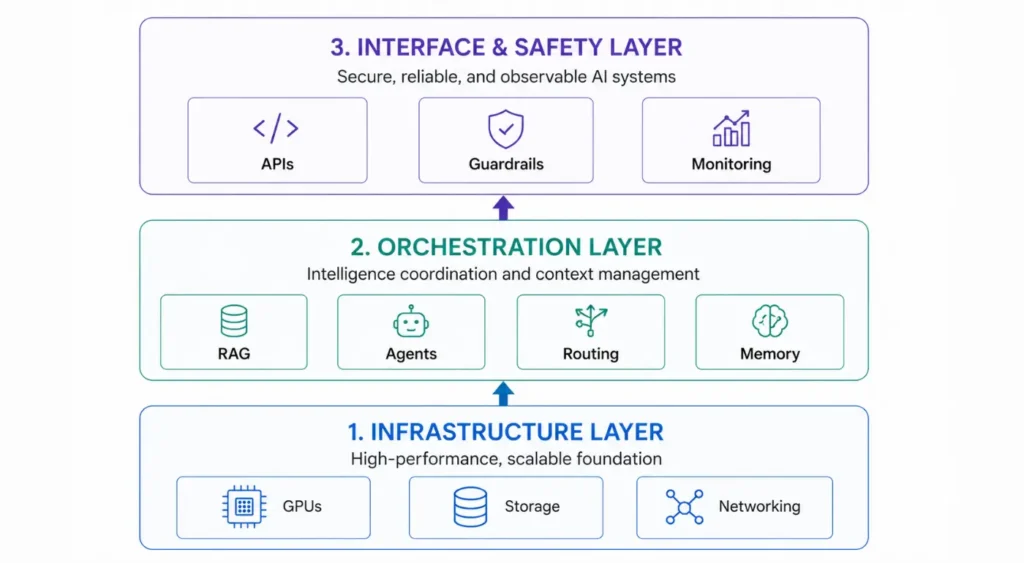
What is critical to recognize is that each of these layers introduces its own dependencies, failure modes, and optimization challenges—independent of the model’s intrinsic capability. A highly capable foundation model embedded in a poorly orchestrated system can underperform a less capable model in a well-engineered one.
Published benchmarks from inference optimization frameworks such as vLLM and TensorRT-LLM demonstrate that for a 70B parameter model, deployment engineering—continuous batching, speculative decoding, optimized KV cache management—can improve throughput by an order of magnitude or more compared to naive serving, while holding latency constant. The capability gap between models is real; the deployment gap between systems is often larger.
These architectural layers—infrastructure, orchestration, interface—define how a model is served. But they still assume a relatively clean boundary: a request arrives, the system processes it, a response returns. Agentic systems dissolve even this boundary. The model is no longer a stateless function called by the system; it becomes an actor within a dynamic, multi-step computational process that the system orchestrates but does not fully control.
Agentic Systems and the Dissolution of the Inference Boundary
The emergence of agentic AI workflows represents perhaps the most significant architectural departure from the model-as-product paradigm. In a traditional inference setting, the boundary between an AI model and its environment is clear: a request arrives, the model processes it, a response is returned. The model is stateless across calls; the system provides the state.
Tool Use and Planning Loops
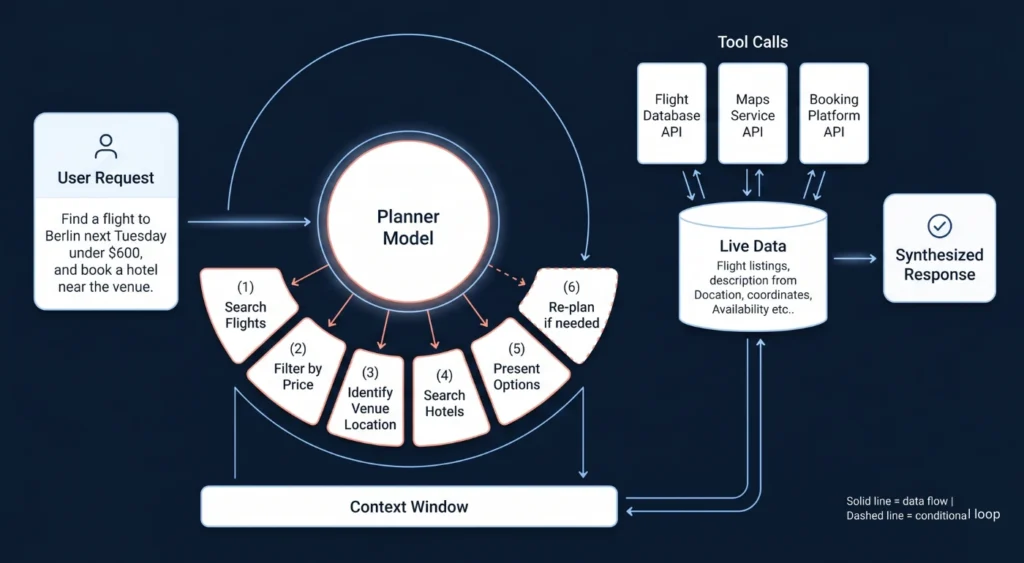
Agentic systems dissolve this boundary. Consider a concrete example. A user asks an AI agent: “Find me a flight to Berlin next Tuesday under $600, and book a hotel near the venue.” The agent does not answer in a single inference call. Instead, it enters a planning loop. First, a planner model breaks the request into subtasks: (1) search flights, (2) filter by price, (3) identify venue location, (4) search hotels, (5) present options for confirmation.
Each subtask triggers a tool call—a structured API request to a flight database, a maps service, a booking platform. The agent executes these calls, receives structured responses (flight listings, coordinates, availability), and feeds them back into the context window. A second inference pass synthesizes the results, checks constraints (“under $600”), and either presents a final answer or initiates another loop if results are incomplete.
The “intelligence” is not in any single model response; it is in the orchestration logic that decides when to call which tool, how to handle API errors, and how to maintain state across a multi-step process. This dissolves the clean boundary between “model” and “system.”
The model provides the reasoning and language understanding, but the system’s tool definitions, error-handling rules, and state management determine whether the task succeeds or fails. The user did not buy a “model”; they bought a capability—book travel—that happens to be implemented by a system in which a model is one component among many.
Dynamic Knowledge and RAG
The flight-booking example illustrates tool use and planning loops. But agentic systems also depend on dynamic knowledge—information that changes too rapidly to be encoded in model weights. This is where retrieval-augmented generation (RAG) enters the architecture. In our flight-booking agent, the model was never trained on real-time flight prices. Instead, when the user asks about “next Tuesday,” a retrieval system queries a live flight database, pulls the current schedule and pricing, and injects that structured data into the model’s context window.
The model’s “knowledge” of available flights exists only for the duration of that inference call. Fine-tune the retrieval pipeline—better indexing, smarter query expansion, more recent data—and the system produces better answers without retraining the model at all. The effective knowledge and capability of the AI system at any given moment is partially determined by external data infrastructure. This is a clear signal that the system, not the model alone, is the appropriate unit of analysis for understanding deployed AI performance.
The same architecture applies beyond consumer travel. Consider a financial research agent tasked with: ‘Analyze Q3 earnings for all S&P 500 tech companies and flag any revenue surprises against consensus estimates.’ The agent does not rely on training data frozen at a cutoff date. Instead, it queries live SEC EDGAR filings, earnings call transcripts, and real-time consensus data feeds through structured API calls.
The retrieval system pulls the most recent 10-Q and 8-K filings, injects them into the context window, and the model synthesizes deviations from analyst expectations. Update the retrieval corpus with this morning’s pre-market earnings release, and the system’s effective knowledge changes immediately—without a single weight update. The intelligence is distributed across the retrieval infrastructure, the API integrations, and the orchestration logic, not concentrated in the model itself.”
Continuous ModelOps and the Living System
The model-system boundary is also dissolved over time, not just across a single task. Continuous ModelOps pipelines extend this further: models are updated through ongoing fine-tuning on production signals, version-controlled and rolled out with A/B testing infrastructure, monitored for behavioral drift, and replaced with newer variants as they become available. A model that scored well on safety benchmarks in January may drift by June as user behavior shifts, new fine-tuning data is introduced, or the retrieval corpus is updated.
Without continuous monitoring and staged rollouts, the “same” model becomes a different system over time—one that the original benchmarks no longer describe. The operational practices borrowed from software DevOps—continuous integration, staged deployment, rollback mechanisms—are now applied to model lifecycle management. The model is, in this sense, a versioned software component within a larger software system.
This system-centric view is powerful, but it is not universally applicable. There are important, well-defined contexts where the model itself remains the primary deliverable—and ignoring them leads to a distorted picture.
The Counterargument: When the AI Model Is Still the Product
Acknowledging the system-level shift does not require dismissing the model as a standalone product. There are important, well-defined contexts in which the model itself remains the primary deliverable, and ignoring them leads to a distorted picture.
Edge and on-device artificial intelligence represent the clearest counterexample. When an AI model is deployed on a smartphone, an embedded sensor, or an autonomous vehicle, the constraints are fundamentally different from cloud-scale inference. Latency requirements are sub-millisecond, connectivity is unreliable or absent, and the surrounding infrastructure is minimal by design.
In these contexts, the model—its size, precision, and architectural efficiency—is the product in a direct and literal sense. The entire engineering challenge is to compress capability into a deployable artifact that can operate without the infrastructure scaffolding that cloud systems take for granted. Model quantization, neural architecture search, and knowledge distillation are product disciplines, not system disciplines.
Similarly, many applications do not require complex orchestration layers. A developer building a support ticket classifier processes 10,000 tickets daily through a single API call per ticket. The model is a 70B parameter generalist, but the task is simple: map ticket text to one of twelve predefined categories. Adding a RAG pipeline to retrieve company policy documents, a multi-agent orchestration layer to “reason” about edge cases, and continuous fine-tuning on production signals would increase latency from 200ms to 2+ seconds per ticket, add infrastructure overhead, and introduce failure modes (retriever downtime, agent loops) that the simple API call avoids. For this use case, the model-as-product interface is not just sufficient—it is optimal.
There is also a capability argument that resists the system-centric framing, though it has limits. Frontier AI models are not commodities, and the intelligence gap between a leading foundation model and a lagging one cannot be closed by systems engineering alone on tasks requiring deep reasoning, novel problem-solving, or nuanced generation.
A better orchestration layer cannot make a weaker model match a stronger one on proving a new mathematical theorem or writing original literary criticism. But on knowledge-intensive or tool-heavy tasks—where retrieval quality, API precision, or workflow design dominates—the system can compensate for meaningful model gaps. The AI model defines the ceiling; the system determines how closely real-world deployment approaches it, and whether the gap between ceiling and floor matters depends on the task.
The tension is real—but it can be resolved by identifying the conditions under which each framing applies.
AI Model or AI System? A Conditional Framework for Production AI
The tension between “model as product” and “model as system component” is not resolved by choosing a side. It is resolved by identifying the conditions under which each framing applies.
The AI model-as-product framing is most accurate when: the deployment environment is resource-constrained (edge, embedded)—a smartphone running a distilled 3B parameter model offline; the use case involves a single, well-defined inference task with minimal context dependency—classifying an email as spam or not spam; the operational scale is below the threshold where infrastructure optimization yields meaningful economic returns—a startup processing thousands rather than billions of requests; and the primary engineering challenge is the capability of the model itself rather than the surrounding integration—compressing a 70B model into 4-bit precision for on-device deployment.
The AI model-as-system-component framing becomes dominant when: deployment scale creates infrastructure costs that dwarf the model’s training cost—serving hundreds of millions of users daily; the task requires dynamic knowledge (RAG), multi-step reasoning (agents), or stateful interaction across sessions—a customer support agent that remembers your order history across three days of troubleshooting; the behavioral contract of the deployed AI must be enforced by architectural guardrails rather than model alignment alone—ensuring a financial advice bot never suggests illegal trades regardless of user prompting; and the lifecycle of the deployed capability involves continuous updates that require operational infrastructure to manage safely—rolling out a new model variant to 5% of users, monitoring for drift, then scaling or rolling back.
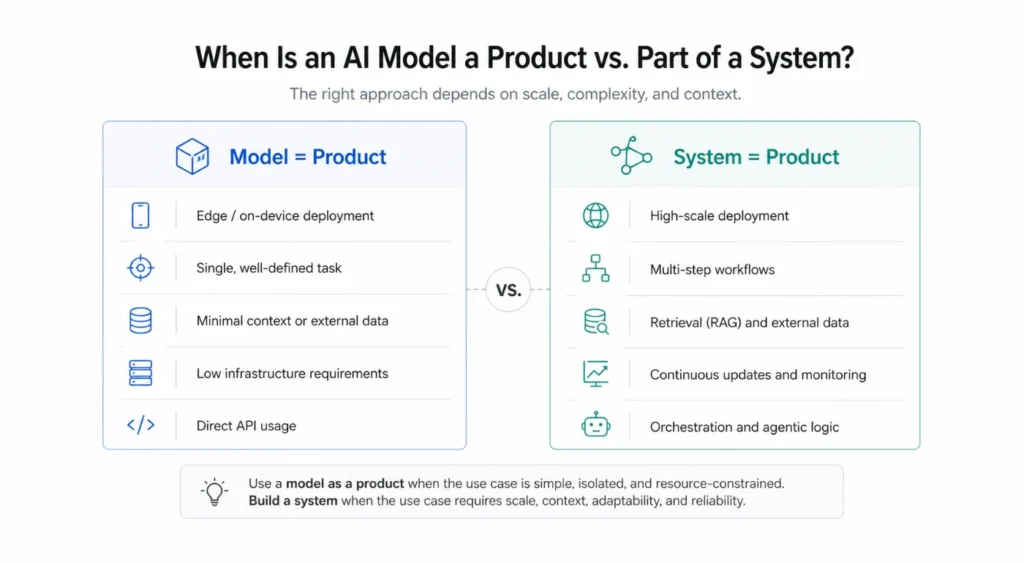
Most frontier AI deployments today span both regimes simultaneously. The same underlying foundation model may be accessed directly via API by one class of developer (model-as-product) while being embedded inside a complex agentic orchestration platform by another (model-as-system). The provider must optimize for both consumption patterns, which is itself an architectural challenge: the model must be capable enough to serve as a compelling product on its own merits, while also being modular and well-specified enough to function as a reliable component in systems it does not control.
Beyond architecture and economics, this shift has clear strategic implications. The provider that can serve both regimes simultaneously—offering a compelling model-as-product API while enabling deep system-level integration—occupies the most defensible position in the market. But this dual optimization is itself a technical challenge that few have mastered.
The Platform Gravity of AI Infrastructure
These two framings are not just analytical tools—they are competitive battlegrounds. The provider that can serve both regimes simultaneously occupies the most defensible market position. This dual capability generates what we might call ‘platform gravity’: as AI systems grow in architectural complexity, they generate switching costs—not at the model layer, but at the infrastructure, orchestration, and integration layers surrounding it.
There is a strategic dimension to this shift that deserves explicit attention. As AI systems grow in architectural complexity, they generate switching costs—not at the model layer, but at the infrastructure, orchestration, and integration layers surrounding it. An organization that has built its retrieval pipelines, fine-tuning workflows, safety filters, and observability tooling around a specific provider’s ecosystem faces substantial migration costs when considering an alternative, even if a competing model offers marginally superior benchmark performance.
But this lock-in is not inevitable. The rise of provider-agnostic orchestration frameworks (LangChain, LiteLLM, OpenRouter) and standardized model APIs means that for many use cases, the model itself remains the most swappable component. The “platform gravity” effect is strongest where organizations have chosen deep vertical integration over abstraction; it is weakest where they have treated the model as a commodity component from the start.
Major providers are explicit about their strategic priority. OpenAI describes its business as one that “scales with the value of intelligence,” with revenue, reinvestment, and capability advancing together. The company’s leadership has called scalable compute “a competitive advantage” requiring “foresight, commitment and the balance sheet to support it”—a clear signal that infrastructure investment is treated as a core differentiator, not merely a cost of doing business. The goal is to make the surrounding ecosystem—developer SDKs, observability tools, orchestration frameworks—sticky enough that customers optimize for total cost of ownership rather than raw model capability.
This does not mean model quality is irrelevant to platform competition; capability remains the entry ticket. But once capability is sufficient, the competitive dynamics shift toward infrastructure reliability, developer experience, latency SLAs, and total cost of ownership—all system-level properties. The transition from “model as a product” to “model as part of a platform” is, in part, a story about where providers believe durable competitive moats can be constructed. Whether those moats hold depends on whether customers accept deep integration or insist on abstraction—a contest that is still unfolding.
Synthesis: The AI System as the New Unit of Accountability
The practical implication of everything argued above is that the AI model alone is an insufficient unit of analysis for evaluating production AI. Performance, cost, reliability, safety, and competitive positioning are all properties of the system. An AI foundation model evaluated in isolation tells you something important—its ceiling—but tells you relatively little about what a specific deployment of that model will actually do at scale.
Understanding this does not require abandoning the model as a concept of value. It requires expanding the frame of analysis to match the operational reality: that AI, at scale and in production, is not a product you deploy once, but a system you operate continuously—monitored, updated, orchestrated, and constrained by infrastructure that is itself a form of engineered intelligence. The AI model is the core; the system is what makes the core useful, safe, and economically viable. At scale, AI is not something you deploy once. It is something you operate—continuously.
Over the next two to three years, we expect this system-centric view to become the default lens for AI infrastructure decisions. Organizations that continue to evaluate AI by model benchmarks alone will find themselves systematically misled about production capability, cost, and risk. The question is no longer ‘Which model?’ but ‘Which system—and can we operate it?
The analysis presented here synthesizes perspectives from AI systems architecture, infrastructure economics, foundation model research, and product strategy. It reflects the state of production AI deployment as of early 2026, a period in which inference infrastructure, agentic orchestration, and ModelOps pipelines have become primary engineering disciplines in their own right.
Sources and references:
- Axios, July 2025. “Altman plans D.C. push to “democratize” AI economic benefits”
- arXiv, February 2026. “Defining AI Models and AI Systems: A Framework to Resolve the Boundary Problem”
- Epoch AI, June 2024. “How much does it cost to train frontier AI models?”
- Deloitte, November 2025. “Why AI’s next phase will likely demand more computational power, not less”
- Stanford University. “The 2026 AI Index Report”
- Nvidia, October 2025. “NVIDIA Blackwell Raises Bar in New InferenceMAX Benchmarks, Delivering Unmatched Performance and Lowest Cost Per Token”
- OpenAI, January 2026. “A business that scales with the value of intelligence”
