


Artificial intelligence (AI) is advancing rapidly, but enterprise adoption is not scaling at the same pace. According to McKinsey’s 2025 State of AI report, 88% of organizations now use AI in at least one business function, yet only around one-third have scaled it meaningfully across their operations. That 55-percentage-point gap is not explained by a lack of model capability. It reflects a deeper constraint rooted in economics, infrastructure, and deployment complexity.
While the most powerful large language models (LLMs) continue to push the boundaries of capability, organizations face a different set of constraints when deploying AI in real-world systems: inference cost at scale, latency requirements for real-time applications, data residency obligations under HIPAA and GDPR, and the engineering overhead of maintaining production AI.
This article examines the growing role of small language models (SLMs) in closing that gap. Here, “small language models” denotes models up to roughly 70 billion parameters—about one‑tenth to one‑hundredth the size of frontier systems such as GPT‑4 or Gemini Ultra. The most practical deployment benefits concentrate below 10 billion parameters, where models can be quantized to run on consumer hardware with 16 GB of RAM. Models between 10B and 70B typically require enterprise GPUs or data‑center infrastructure, but still deliver substantially lower cost and higher throughput per dollar than 400B+ frontier systems.
SLMs are not a compromise for organizations too cost-constrained to use the best available artificial intelligence. They are a structurally different category of system—one optimized for deployment economics rather than benchmark performance—and their rise reveals how the industry’s center of gravity is shifting from capability to deplorability.
The Gap Between AI Capability and Deployment
There is a persistent gap between what AI systems are capable of and what enterprises are able to deploy at scale. The McKinsey data establishes the symptom: widespread experimentation, limited scaling. The cause is more specific than “deployment complexity” as a generic label.
Economics first. Running a frontier model like GPT-4o at enterprise scale—millions of tokens per day across thousands of users—can cost $50,000 to $200,000 monthly in API fees alone. For a mid-size company, this is not a technology budget line item; it is a structural cost that competes with headcount and real estate. The price per token has fallen dramatically, but Jevons effects—the paradox that cheaper resource use tends to increase total consumption— dominate: lower prices expand usage faster than they reduce total spend.
Infrastructure second. Frontier AI models require GPU clusters that most enterprises do not own and cannot easily access. Cloud API access solves the hardware problem but introduces latency, rate limits, and vendor dependency. A customer support bot that takes three seconds to respond because of network round-trips is not a user experience issue; it is a product failure.
Governance third. HIPAA, GDPR, and sector-specific regulations often prohibit sending sensitive data to external API endpoints. A hospital cannot route patient records through a third-party language model, regardless of how capable that model is. The compliance boundary is hard, not negotiable.
These three constraints—cost, latency, compliance—are not theoretical. They determine which AI deployments survive budget reviews, which products ship, and which pilots die in committee. What is emerging, as a result, is a shift in how enterprises approach artificial intelligence. Instead of relying exclusively on the largest and most capable systems, many are turning toward smaller, more efficient models that can be deployed at lower cost, with lower latency, and with greater control over data.
Understanding this shift requires reframing how artificial intelligence progress is measured. For enterprise deployment, the binding question is often not how intelligent a model can become, but how efficiently that intelligence can be delivered within real-world constraints.
The Collapse of Inference Costs
This shift in enterprise behavior is not driven by a single technological breakthrough, nor by a sudden change in organizational priorities. It is emerging from a more fundamental change in the economics of how AI systems are deployed.
To see it clearly, it helps to look beyond model capabilities and focus instead on what it actually costs to run AI at scale. Because while the intelligence of frontier systems has continued to improve, the economics of using them in real-world applications have moved in a very different direction. The clearest signal of this divergence appears in inference pricing.
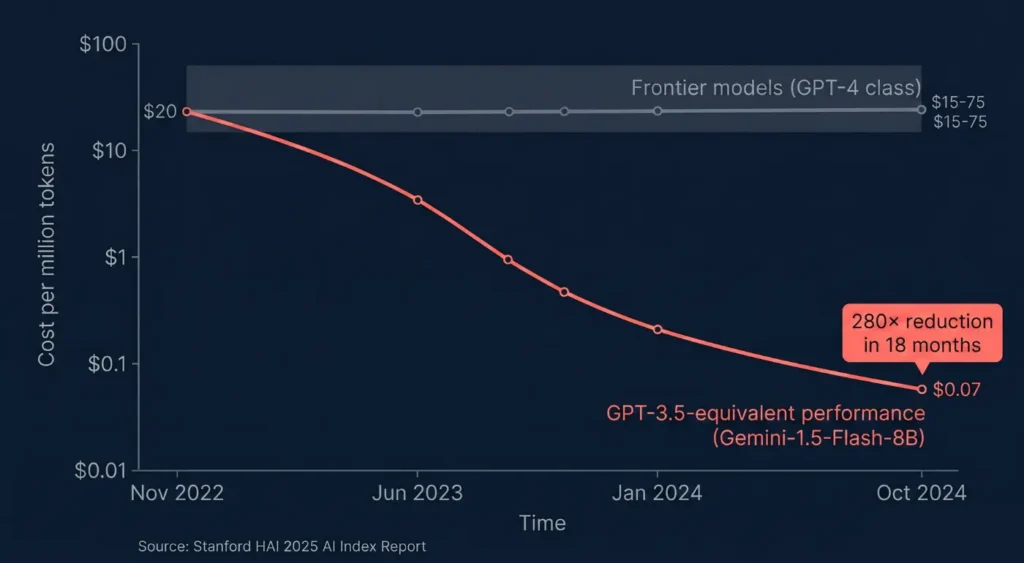
According to Stanford’s 2025 AI Index Report, the cost to achieve a fixed performance threshold—equivalent to GPT-3.5’s score on the MMLU benchmark—dropped from $20 per million tokens in November 2022 to $0.07 per million tokens by October 2024 (achieved by Google’s Gemini-1.5-Flash-8B), a 280-fold reduction in roughly 18 months. That is not a gradual reduction. It is a compression of economics so rapid that it effectively created a new market segment almost overnight.
Within that broader decline, the most striking data point involves SLMs specifically. Frontier AI models accessed via API can cost $15 to $75 or more per million tokens, depending on the provider and capability tier. SLMs—running on optimized infrastructure, edge devices, or standard enterprise servers—can reduce that cost by one to two orders of magnitude
Clarifai, an AI infrastructure vendor, reports its Reasoning Engine achieving 544 tokens/s at $0.16 per million tokens on a 120B open-source model—an indication of how low optimized serving can push costs even for large models. SLMs, with their inherently lower compute requirements, sit well below this floor. Real-world performance varies by workload and configuration, and vendor benchmarks should be read accordingly.
The gap between these figures is not merely a pricing curiosity. It is a structural fact about which types of AI systems are economically viable for high-volume enterprise workloads.
Consider what that pricing differential means in practice. A company running a customer support system that processes ten million tokens per day—a modest scale for a mid-size enterprise—faces a cost difference of several orders of magnitude depending on whether it uses a frontier AI model or a small language model. Multiply that by twelve months, and the total cost of ownership diverges so sharply that the decision becomes less about model preference and more about financial sustainability.
This is the signal: for high-volume enterprise workloads, the most deployable systems are increasingly the most economically viable—and that shift is reshaping which models enterprises actually choose to run.
Why AI Economics Favor SLMs
Training a large language model is an enormous one-time capital expenditure. According to Epoch AI, training GPT-3 cost between $2 and $4 million in 2020. Google’s Gemini, released in late 2023, cost an estimated $30-191 million to train, while GPT-4 cost $41-78 million. These figures represent compute costs only; staff salaries can add 29-49% to the total.
These numbers reflect the underlying logic of frontier AI development: each successive generation requires exponentially more compute to achieve meaningful capability gains. The organizations pursuing this path—a small group of well-capitalized AI labs—are essentially engaged in a race where the prize is general intelligence, and the cost of entry keeps rising.
But training cost is not the same as deployment cost. Once an AI model is trained, running it repeatedly at scale—inference—is a separate economic problem. And it is a problem that SLMs are fundamentally better positioned to solve.
SLMs require less memory bandwidth, less compute per inference call, and less specialized hardware. They span a wide deployment range: the smallest—3 billion parameters, quantized to 4-bit precision—can run on consumer laptops with 16GB RAM. Mid-range SLMs at 7-13B parameters run efficiently on single Nvidia A100 GPUs or comparable AI accelerators. At the upper end of the SLM category, 70B models still need data-center infrastructure, though at substantially lower cost and higher throughput per dollar than 400B+ frontier AI models.
This distinction between training economics and inference economics is why the LLM-versus-SLM comparison has become so consequential for enterprise strategy. Frontier labs and enterprises operate with different time horizons and risk tolerances. The former bet on expanding what is possible; the latter on delivering what is practical. Neither is wrong, but only the latter determines whether AI becomes infrastructure or remains demonstration. Capability wants scale; deplorability wants efficiency. These two optimization targets pull in opposite directions.
For high-volume, routine tasks, the most capable AI model is rarely the most cost-effective to deploy. Enterprises are not irrational for preferring SLMs. They are responding logically to a cost structure that frontier AI was never designed to accommodate.
How Enterprises Are Rebuilding AI Around Efficiency
The most significant of these changes involves the rise of open-source AI. A report by the Linux Foundation shows that by mid-2025, among organizations using AI in any form, 89% incorporate open-source components somewhere in their infrastructure. Two-thirds say it is cheaper to deploy than proprietary alternatives; nearly half cite cost savings as a primary reason for adoption.
The shift from frontier APIs to SLMs is not hypothetical. Epic Systems, one of the largest healthcare IT providers in the United States, integrated Microsoft’s Phi-3 model into its workflows to handle patient inquiries. The deployment runs on-premises, ensuring HIPAA compliance by keeping sensitive data within hospital networks, while achieving faster response times than cloud-based alternatives. The model was chosen not for maximum capability—frontier models could generate more eloquent prose—but because its size and efficiency made on-premise deployment practical, turning a regulatory requirement into a competitive advantage.
Open-source adoption also enables something that purely cloud-based frontier AI cannot easily offer: on-premise AI deployment. This is particularly consequential for industries subject to strict data governance requirements. Healthcare organizations operating under HIPAA, financial institutions navigating regulatory frameworks, and European enterprises bound by GDPR cannot always route sensitive data through external API endpoints.
Running a small language model on internal infrastructure gives these organizations the ability to use AI without compromising their compliance obligations or their data residency requirements. The conversation about AI total cost of ownership therefore extends beyond direct pricing to include the risk and legal costs of data exposure—costs that are difficult to quantify but very real.
Latency and performance are equally important system effects. AI latency—the time between a user prompt and a model response—is not merely a user experience detail. For real-time applications such as coding assistants, live customer service agents, or manufacturing quality control systems, latency determines whether AI is usable at all.
SLMs, running on optimized AI infrastructure—from single Nvidia A100 GPUs to compact on-premise clusters—can achieve throughput of hundreds of tokens per second, enabling genuinely real-time interactions. Frontier AI models accessed through cloud APIs introduce network latency, queuing delays, and rate limits that make them unsuitable for many latency-sensitive applications, regardless of their raw capability.
Perhaps most telling is the adoption pattern around AI agents. According to McKinsey’s 2025 State of AI report, 62% of organizations are either experimenting with (39%) or scaling (23%) AI agents as of late 2025—systems that take sequences of actions, make decisions, and interact with external tools and databases over extended workflows. These agent architectures, by design, generate many inference calls per task rather than one.
The economics of using frontier AI models at $15-75 per million tokens for agentic workflows are often prohibitive. A single customer support ticket resolved by an agentic system might require 10-20 model calls; at frontier prices, that ticket costs $0.30-1.50 in inference alone. For a team handling 10,000 tickets daily, the monthly inference bill exceeds $100,000—before accounting for the other tools, databases, and orchestration layers the agent requires. Small language models, with dramatically lower per-call costs, make agentic AI economically practical in a way that frontier AI models simply do not.
Taken together, these changes reveal a structural shift: enterprise AI adoption is increasingly shaped by systems that can be deployed efficiently at scale, not merely by those that score highest on capability benchmarks.
Where SLMs Fall Short
The shift toward SLMs reflects a clear economic logic, but it also introduces meaningful trade-offs. Ignoring them is a strategic error.
SLMs are not universally capable substitutes for their larger counterparts. On complex multi-step reasoning tasks, nuanced legal analysis, sophisticated creative generation, or open-ended research synthesis, frontier AI models retain meaningful performance advantages.
The gap has narrowed significantly with improved training techniques, instruction tuning, and quantization methods, but it has not closed entirely. Enterprises that deploy SLMs for tasks that genuinely require frontier-level reasoning may find themselves dealing with subtler but consequential errors—a class of failure that is more difficult to detect than an obvious wrong answer.
A frontier AI model might correctly identify a contractual loophole in a merger agreement; an SLM might miss it entirely while producing grammatically flawless, confidently stated analysis that appears correct to a non-expert reviewer.
Implementation complexity is also easy to underestimate. Deploying an open-source model on-premise requires infrastructure expertise, ongoing maintenance, and model update management that proprietary cloud APIs handle automatically.
For organizations without mature ML engineering teams, this overhead can erode or eliminate the cost advantages of smaller models. Total cost of ownership calculations that account only for inference pricing sometimes neglect the engineering labor required to operate, monitor, and update self-hosted AI systems.
Fine-tuning, while a powerful tool for adapting SLMs to specific enterprise domains, introduces its own costs and risks. A fine-tuned model trained on proprietary company data requires careful data governance, version control, and evaluation procedures. Done poorly, fine-tuning can produce AI models that perform well on narrow benchmarks while failing unpredictably in production.
These trade-offs do not invalidate the case for smaller models in enterprise AI adoption—they contextualize it. The real challenge is not choosing between frontier AI and SLMs, but designing systems that route each task to the right model: frontier models for complex reasoning, SLMs for high-volume routine work, and orchestration layers that decide which to call when.
The Shift From Intelligence to Deployment
Stepping back from the pricing data and the infrastructure considerations, there is a structural insight that this shift reveals about the AI industry’s medium-term trajectory.
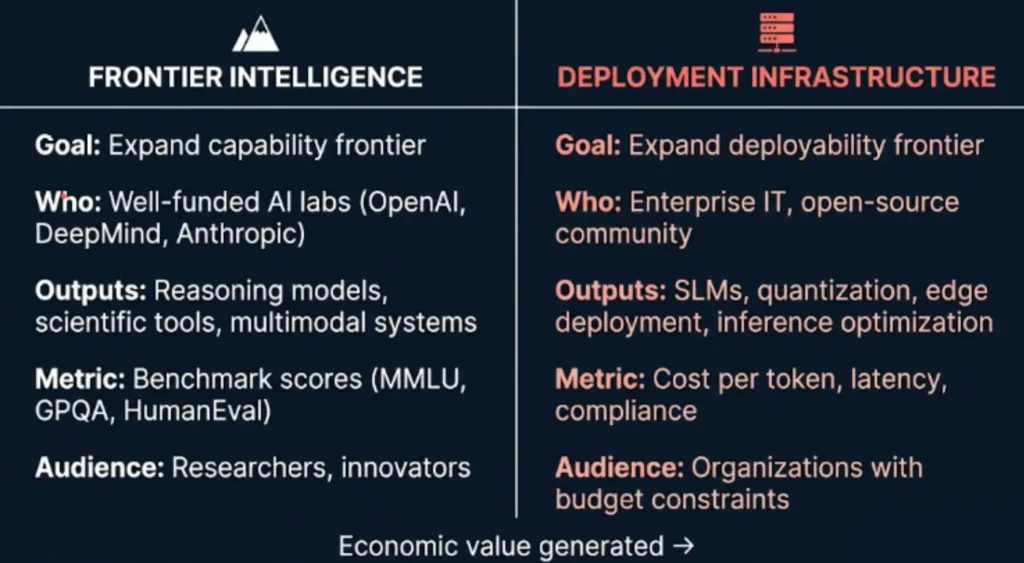
AI development is bifurcating into two distinct layers that serve fundamentally different purposes. The first layer is frontier intelligence: the continuing race among a small number of well-funded labs to push the boundaries of what AI systems can understand, reason about, and generate.
This race is real, and its outputs—reasoning models, multimodal systems, scientific discovery tools—represent genuine advances in human capability. But this layer is not primarily concerned with enterprise deployment economics. It is concerned with expanding the frontier of what is possible.
The second layer is deployment infrastructure: the expanding ecosystem of small language models, optimization techniques, open-weight releases, inference hardware improvements—from new AI chip architectures to more efficient GPU generations—and enterprise tooling that makes AI practically usable at scale across organizations with real budget constraints and real compliance obligations.
This layer is not advancing the frontier of intelligence. It is advancing the frontier of deployment—and in doing so, it is enabling the vast majority of economic value that AI will generate over the next decade.
The common assumption has been that these two layers are in competition—that SLMs represent a compromise, a second-best option chosen by enterprises too cost-constrained to use the best available AI. The more accurate framing is that they serve different markets with different optimization criteria.
An enterprise running AI inference across millions of customer interactions per month does not need general intelligence. It needs reliable, fast, private, and affordable task completion—and SLMs deliver this in ways that frontier AI models, priced and architected for capability maximization, do not.
The companies that will lead in enterprise AI adoption over the next five years are not necessarily those with access to the most powerful models. They are those that develop the organizational and technical competence to deploy AI efficiently—to identify which tasks require frontier reasoning, which can be handled by smaller specialized models, and how to build infrastructure that optimizes across both. This is a capability that is fundamentally about systems thinking and deployment economics rather than access to raw intelligence.
The AI industry entered this decade defined by a race for maximum intelligence. The next phase of its maturation will be defined by a different kind of competition—quieter, less visible, but ultimately more consequential for how AI integrates into the fabric of economic activity. It is a race for efficient deployment. And in that race, the winners will not be those who choose between small language models and frontier APIs, but those who build systems that use both—routing routine tasks to efficient SLMs, complex reasoning to frontier models, and managing the infrastructure that makes the combination economically viable.
This article is being provided for educational purposes only. The information contained in this article does not constitute a recommendation from Intellaix to the recipient, and Intellaix is not providing any financial, economic, legal, investment, accounting, or tax advice through this article or to its recipient.
Sources and references:
- McKinsey & Company, November 2025. “The state of AI in 2025: Agents, innovation, and transformation”
- National Library of Medicine, November 2024. “Health Insurance Portability and Accountability Act (HIPAA) Compliance”
- Intersoft Consulting. “General Data Protection Regulation”
- Stanford University. “The 2025 AI Index Report”
- Clarifai, March 2026. “The Best Small Models for Cost‑Efficient APIs: A 2026 Guide with Clarifai Insights”
- Epoch AI, June 2024. “How much does it cost to train frontier AI models?”
- The Linux Foundation, June 2025. “Open Source AI is Transforming the Economy—Here’s What the Data Shows”
- Deviniti, April 2025. “Small Language Models for enterprise AI: Challenges, benefits, and deployment strategies”
