


Artificial intelligence (AI) is widely perceived as a software-driven technology, delivered through models, APIs, and applications that can be deployed and scaled across digital environments. This framing suggests that, like other forms of software, AI systems should benefit from low marginal costs and efficient scaling once developed.
In practice, modern AI systems behave very differently. As frontier AI models have grown in size and capability, the resources required to train and operate them have expanded rapidly. Research from Epoch AI shows that the cost of training frontier models has increased by approximately 3.5 times per year since 2020 — from roughly $2 million for GPT-3 to nearly $390 million for the largest runs in 2024. This trajectory reflects not only larger models but also the growing infrastructure required to support them.
This shift reveals a fundamental change in how AI systems operate. Rather than scaling primarily through software, they increasingly depend on large-scale physical infrastructure, including specialized AI chips, energy supply, and high-speed data movement. As a result, AI cost is not determined solely by model complexity, but by the infrastructure required to sustain and scale these systems.
Understanding AI cost therefore requires looking beyond individual components such as GPUs or data centers. It requires examining how multiple layers of infrastructure—compute, memory, networking, and power—interact as a system, and how scaling one part of that system increases the demands on the others. This systemic perspective is essential for hyperscalers and enterprises alike as they plan AI infrastructure investments.
What “AI Cost” Actually Means
Compute is often the main focus when discussing AI cost. GPUs and specialized AI chips are widely recognized as expensive, and their role in training large models has made them the primary reference point for estimating cost. While this perspective captures part of the picture, it does not reflect how AI systems actually operate at scale.
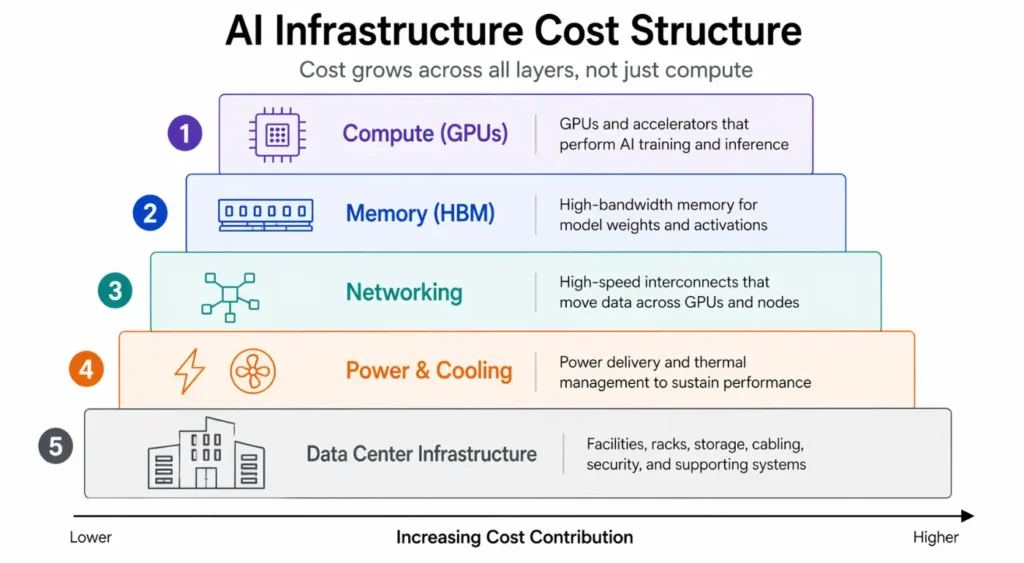
Operationally, AI cost emerges from a combination of interdependent infrastructure layers. Compute is only one element within a broader system that also includes high-bandwidth memory (HBM), networking infrastructure, power delivery, cooling, and the facilities—the data centers—required to house and operate these components. Each of these layers contributes to the total cost, and none of them can be scaled independently.
Industry analyses of large-scale AI infrastructure suggest that hardware typically represents the largest single cost category. A 2024 arXiv paper breaks down the full development cost of notable frontier AI models — including GPT-3, GPT-4, and Gemini Ultra — finds that computing hardware accounts for 47% to 65% of total amortized cost, while R&D staff costs represent 29% to 49% when including equity compensation. Energy comprises only 2% to 6%. This distribution highlights an important point: even if compute hardware were to become more efficient or less expensive, the overall cost of AI systems would still depend on the ability to support and operate that hardware within a larger system.
This structure also distinguishes AI from traditional software. In many software systems, the cost of serving additional users is minimal once the product is built. In AI systems, however, each use of the model consumes computational resources, introducing a recurring cost tied to usage. Unlike training, which is a one-time cost, inference introduces continuous operating expenses that scale with usage.
For widely deployed frontier AI systems, inference can eventually dominate total lifetime cost — a dynamic that makes usage volume, not just model capability, a central economic variable. Industry estimates suggest that serving a large language model (LLM) at scale can incur inference costs measured in hundreds of thousands of dollars per day, with some widely used systems reportedly requiring millions of dollars in weekly compute expenditure. Thus, AI costs span both model-building and ongoing runs.
The structure of this cost can be understood as a layered system:
The transition from a software-driven model to an infrastructure-heavy one is most visible in the capital expenditure of the industry’s hyperscalers. In traditional Software as a Service (SaaS), infrastructure spend typically scales incrementally with user growth; however, in the AI era, investment must precede capability at an unprecedented scale.
In early 2026, Reuters reported that Microsoft, Alphabet, and Meta were projected to collectively spend more than $500 billion on AI capital expenditure for the year, with Alphabet alone signaling infrastructure investment of $175 billion to $185 billion to secure the power, land, and chips — from Nvidia A100 and H100 generations to the latest B200 architectures — necessary for the next generation of frontier AI models. This giga-scale investment confirms that artificial intelligence is no longer an asset-light digital trade, but a capital-intensive industrial race where the entry fee is measured in hundreds of billions of dollars.
The cost of AI is a systemic phenomenon. It is not defined by a single component or a single stage of development, but by the combined cost of building, operating, and scaling a tightly integrated AI infrastructure.
Why Compute Is Only the Starting Point
AI compute is a key component of modern AI systems, and is often the first step in understanding how AI costs are structured. Training and deploying large language models requires thousands of specialized AI chips — Meta trained its Llama 3.1 405B model on more than 16,000 H100 GPUs, while xAI assembled a 100,000-GPU cluster in Memphis for Grok training. The price of these systems has made compute the most visible and widely discussed component of AI infrastructure.
Individual high-performance processors carry substantial costs, though Nvidia typically does not publish retail prices directly. Cloud infrastructure provider Jarvis Lab lists the Nvidia H100 starting at approximately $25,000, while early cloud platform listings for the B200 192GB SXM range from roughly $45,000 to $50,000 per unit, with complete 8x B200 server systems exceeding $500,000. Hourly rental rates vary significantly — from approximately $5.87 per hour on developer-focused platforms to $18.53 per hour on major enterprise clouds — reflecting differences in bundling, quota requirements, and support levels.
This dependency becomes more pronounced as systems grow. Increasing the number of GPUs raises the demand for memory bandwidth to feed them with data, for networking capacity to synchronize their operations, and for power and cooling to sustain their performance. Expanding AI compute capacity initiates a chain of requirements that extend beyond the processors themselves, particularly for hyperscalers operating at the frontier of AI model development.
As a result, AI cost cannot be understood by looking at compute alone. While GPUs and specialized AI chips represent a significant portion of the initial investment, they are part of a broader system in which each component must scale alongside the others. Compute is therefore best understood not as the full cost driver, but as the starting point of a larger infrastructure that determines how AI systems operate and how their costs evolve.
The Infrastructure Behind AI Cost
The total cost of ownership (TCO) for AI systems extends far beyond compute, as every processor relies on a complementary array of enabling components to function effectively. These components aggregate into successive layers of infrastructure, each imposing incremental costs and, critically, escalating in resource demands as the overall system scales. While this section examines the infrastructure layers that compose TCO, the operational dynamics of utilization and efficiency — and their impact on total cost — are explored separately in a dedicated TCO section below.
One of the most critical of these layers is memory. Modern AI workloads require high-bandwidth memory (HBM) to deliver data to processors at the speed required for training and inference. Unlike standard DRAM, HBM stacks memory dies vertically and connects them directly to the processor through a silicon interposer, a manufacturing process that is significantly more complex and costly.
In advanced processors like the Nvidia B200, HBM has transitioned from a supporting component to a primary cost driver, representing a substantial share of total manufacturing cost. As AI models grow, they do not just require more math; they require more memory to store trillions of parameters, ensuring that HBM remains a fundamental cost floor that keeps AI infrastructure prices elevated.
Networking introduces another layer of dependency. In large-scale AI systems, thousands of processors must coordinate their work, exchanging data continuously. As cluster size grows, the number of required network links increases non-linearly, and the switching architecture — whether Fat-Tree, dragonfly, or other topologies — must expand to maintain bandwidth between nodes. This complexity compounds costs.
The same arXiv analysis of frontier training costs reveals that cluster-level interconnects represent 9% to 13% of total amortized costs. When accounting for the total networking overhead required for multi-node coordination — including fabric expansion and switching architecture — that figure can climb significantly higher. At this scale, the network is no longer a secondary component for hyperscalers; it is a defining economic constraint.
Power and cooling further expand the cost structure. High-performance processors operate at significant power levels, and as system density increases, so does the energy required to run and maintain them. The physical reality of this scaling is best illustrated by the transition from the Nvidia H100 to the Blackwell B200 architecture.
According to Nvidia specifications, the H100 operates at a maximum thermal design power (TDP) of up to 700W (configurable), while the Blackwell generation pushes power demands to 1,200W per unit — with the Blackwell Ultra variant reaching up to 1,400W — a jump that fundamentally breaks traditional data center design.
At this level of thermal density, conventional air-cooling systems are no longer physically capable of removing heat efficiently. This has forced a mandatory pivot to liquid cooling infrastructure, which adds a significant premium to the initial facility build cost.
Together, these layers — memory, networking, and power — form the supporting infrastructure that allows AI compute to function. Each layer introduces its own cost, and each must scale alongside compute, creating interdependencies that shape how AI costs evolve as systems grow. Consequently, AI cost is shaped not by a single component, but by the combined requirements of an interconnected AI infrastructure system.
The Constraint Multiplier Effect in AI Systems
The interaction between compute and its supporting infrastructure creates a compounding effect on AI cost. As systems scale, increasing one component does not produce a proportional increase in capability at a fixed cost. Instead, it requires coordinated expansion across multiple layers of AI infrastructure.
Expanding compute capacity illustrates this dynamic clearly. Adding more processors increases the amount of data that must be delivered to them, placing greater demands on memory bandwidth. At the same time, the coordination between processors becomes more complex, requiring higher network throughput and more sophisticated communication architectures. These changes do not occur independently; they emerge as direct consequences of scaling the system.
Power and cooling follow a similar pattern. As compute density increases, the energy required to operate the system rises, along with the infrastructure needed to manage heat and maintain reliability. Supporting larger clusters therefore involves not only purchasing additional hardware, but also expanding the physical systems that sustain it.
This effect becomes visible at scale. For hyperscalers expanding a GPU cluster from 10,000 to 100,000 processors, the supporting infrastructure does not expand by the same factor — it expands faster. Unlike traditional cloud infrastructure, where doubling server count roughly doubles capacity at proportionate cost, AI infrastructure requires disproportionate investment in interconnects, memory, and power as it grows.
For example, Meta in 2025 undertook a facility reconfiguration unprecedented in the company’s history: it emptied five existing production data centers — facilities originally designed for standard social media and cloud workloads — to build a single, unified 129k H100 GPU cluster. This was not incremental expansion; it was a structural transformation. Traditional data centers operate as independent buildings, but frontier AI models require dense, interconnected clusters functioning as one cohesive machine, with every GPU linked through high-bandwidth networking and sustained by liquid cooling infrastructure that existing facilities could not support.
A standard data center can add racks incrementally; a frontier AI cluster must expand networking fabric, HBM capacity, and liquid cooling simultaneously to maintain performance. This is why the industry’s collective AI capital expenditure has crossed into the hundreds of billions — the multiplier effect turns linear compute growth into super-linear infrastructure investment.
This interdependence creates a multiplier effect. Adding compute triggers additional requirements across memory, networking, and power. The result is that total AI cost does not scale linearly with any single component, but increases across the system as a whole. In practical terms, scaling AI systems means scaling everything at once.
This relationship can be visualized as follows:
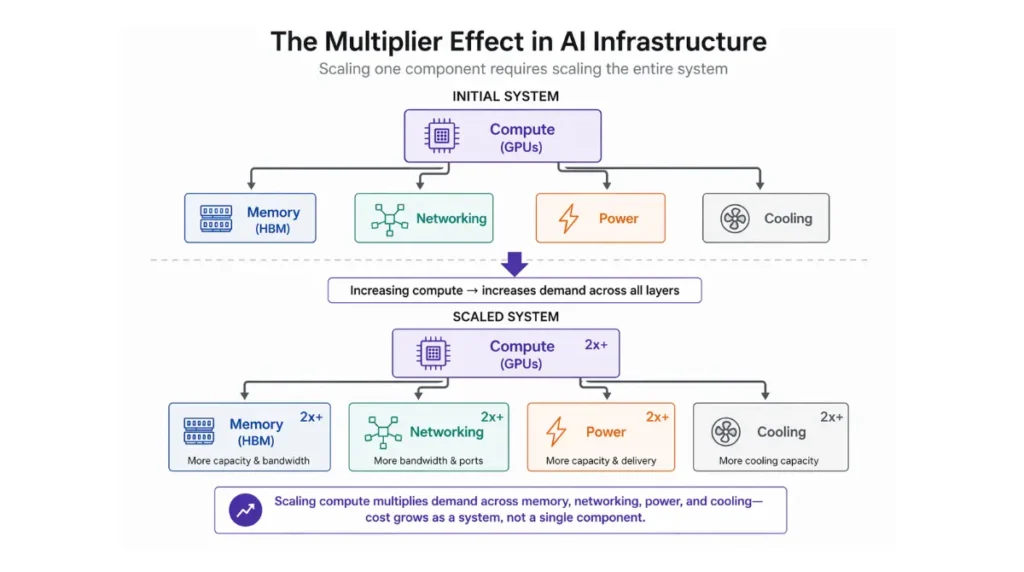
In this sense, the AI cost is not determined by the most advanced component, but by the most constrained one. When any layer fails to scale in proportion to the others, it limits overall system performance, requiring further investment to restore balance. As systems grow larger, these constraints shift rather than disappear, and each shift brings additional cost.
Understanding this dynamic is essential to explaining why AI cost increases over time. The challenge is not simply to add more compute, but to expand an entire AI infrastructure in which each layer depends on the others. Therefore, cost emerges from the structure of the system itself, rather than from any single technological limitation.
Total Cost of Ownership (TCO) in AI Systems
In addition to the investments in AI infrastructure, the effectiveness of that infrastructure is also a significant factor in the overall cost of artificial intelligence. This broader perspective is often described as total cost of ownership (TCO), which includes not only the initial capital expenditure for hardware, but also the ongoing costs of operating and maintaining the system. These include energy consumption, cooling, maintenance, and the personnel required to manage large-scale infrastructure. Over time, these operational factors can represent a substantial portion of total AI cost.
While the scale of AI infrastructure is a primary cost driver, the efficiency with which that infrastructure is used determines its ultimate economic value. High-performance AI hardware is uniquely sensitive to underutilization; unlike traditional cloud servers, an idle GPU continues to draw significant power and incur high amortized capital costs. In production environments, this often manifests as “cluster bloat” — the accumulation of provisioned capacity that exceeds actual workload requirements.
According to the NVIDIA Developer Blog (March 2026), fragmented workloads frequently leave GPU compute utilization hovering between 0% and 10%. This massive latent capacity forces organizations to over-provision and invest in additional nodes to meet peak demands, even when existing hardware sits mostly idle. For large-scale operations, failing to bridge this gap transforms a high-performance system into a significant financial liability.
At these levels, a significant portion of the infrastructure remains underused, while still consuming power and incurring operational costs — meaning a large share of the budget is effectively lost through unused capacity that still requires energy and cooling to maintain.
When utilization improves, the cost advantage of owned infrastructure increases significantly, while low utilization raises the cost of each unit of work, as the same infrastructure produces less usable compute. This dynamic makes efficiency a critical factor in AI economics, often as important as the scale of the system itself. For hyperscalers operating at the frontier of AI model development, improving utilization from 10% to 50% can effectively multiply available compute without additional hardware investment — a leverage point that directly impacts AI cost trajectories.
For organizations that do not sustain consistently high utilization, cloud rental — where hourly rates for comparable GPU instances range from approximately $5.87 to $18.53 depending on provider and configuration — can yield lower TCO than ownership, despite higher unit costs. This trade-off is particularly relevant for AI model development workflows with variable or unpredictable compute demands.
To fully understand total cost of ownership, it’s necessary to look beyond the size of the AI infrastructure and consider how it is operated. In large-scale AI systems, cost is not determined solely by what is built, but by how consistently and efficiently it is used.
Why AI Costs Keep Rising Despite Efficiency Gains
Advances in hardware and system design have made AI systems more efficient over time. Each generation of AI chips delivers greater performance per watt — the transition from Nvidia’s Hopper (H100) to the Blackwell (B200) architecture, for instance, significantly increases throughput per unit of energy (efficiency).
Within these families, HGX H100 and HGX B200 illustrate this progression: the B200 achieves 2.3× faster throughput at FP16 precision and up to 15× greater energy efficiency for AI inference compared to the H100, equivalent to a 93% reduction in energy consumption for the same inference workload. Improvements in software and architecture further reduce the cost of individual operations. Taken alone, these gains would suggest that AI cost should decline as the technology matures.
In practice, the opposite trend has emerged. While efficiency continues to improve, the scale of AI systems expands even faster. The Epoch AI research, mentioned earlier, indicates that the compute used to train frontier AI models has been growing at approximately five times per year since 2020 — a rate that outpaces the efficiency gains provided by hardware improvements alone.
This imbalance creates a consistent upward pressure on total cost. As systems become more capable, they are also deployed at larger scales, requiring more infrastructure across compute, memory, networking, and power. Each improvement in efficiency makes it feasible to build larger models or process more data, which in turn increases the overall demand for resources.
This dynamic reflects the Jevons paradox — a well-documented pattern in infrastructure-driven systems where efficiency gains reduce unit cost but increase total demand. In artificial intelligence, improvements in performance are often reinvested into scale: better hardware makes it feasible to train larger AI models on more data, which in turn increases the overall demand for AI infrastructure. The result is higher total expenditure even as the cost of individual operations declines.
Thus, AI cost continues to rise not because efficiency is lacking, but because the system expands to absorb those gains. This trajectory is not physically inevitable; it is driven by the competitive pursuit of frontier AI capability, where each improvement is reinvested into larger scale. The constraint is not removed; it shifts, and the system grows to meet new limits. This reinforces the underlying structure of AI economics, where cost is determined by how the system scales rather than how efficiently individual components perform.
AI Economics as a Structural Constraint
The structure of AI cost has direct implications for how the industry evolves. As infrastructure requirements expand across compute, memory, networking, and power, the capital needed to build and operate advanced AI systems increases accordingly. This shifts artificial intelligence away from a software-driven model and toward one defined by large-scale, coordinated investment.
At this scale, the ability to develop and deploy frontier AI models is no longer determined solely by technical capability. It increasingly depends on access to capital, AI infrastructure, and the operational capacity to manage complex systems. Hyperscalers — with annual capital expenditure measured in the tens of billions — dominate this tier, while smaller organizations and national initiatives face a widening gap between ambition and feasible investment.
This dynamic reinforces a broader structural pattern. The cost of scaling AI systems does not arise from a single component, but from the need to expand multiple interdependent layers simultaneously. Each improvement in capability requires additional investment across the system, linking technological progress directly to capital intensity.
AI does not become expensive because models are inherently complex. It becomes expensive because every increase in capability requires scaling a tightly coupled AI infrastructure system — compute, memory, networking, and power in concert. This relationship between cost and structure defines how AI systems are built, and who is able to build them.
As artificial intelligence continues to evolve, its trajectory will be shaped by advances in algorithms and model design, and by the ability to finance and operate the AI infrastructure that supports them. Open-weight models and efficiency improvements may lower barriers to deployment and application, but the frontier of training remains capital-intensive. In this sense, AI economics are not a secondary consideration — they are a defining constraint on the system itself.
This article is being provided for educational purposes only. The information contained in this article does not constitute a recommendation from Intellaix to the recipient, and Intellaix is not providing any financial, economic, legal, investment, accounting, or tax advice through this article or to its recipient.
Sources and referrences:
- Epoch AI, February 2026. “Trends in Artificial Intelligence”
- arXiv, May 2024. “The rising costs of training frontier AI models”
- AWS Amazon. “What is SaaS (Software as a Service)?”
- Reuters, February 2026. “Alphabet says capital spending in 2026 could double, cloud business booms”
- Meta, July 2024. “Introducing Llama 3.1: Our most capable models to date”
- Supermicro, 2024. “Inside the 100K GPU xAI Colossus Cluster that Supermicro Helped Build for Elon Musk”
- Jarvis Labs, March 2026. “NVIDIA H100 Price Guide 2026: GPU Costs, Cloud Pricing & Buy vs Rent”
- Nortflank, August 2025. “How Much Does an Nvidia B200 GPU Cost”
- Fast Shipping, April 2025. “Fat Tree Topology”
- Huawei, November 2024. “What Is Dragonfly Adaptive Routing?”
- Nvidia. “Nvidia H100 GPU”
- Nvidia Developer, August 2025. “Inside NVIDIA Blackwell Ultra: The Chip Powering the AI Factory Era”
- Engineering at Meta, September 2025. “Meta’s Infrastructure Evolution and the Advent of AI”
- Nvidia Developer, March 2026. “Maximize AI Infrastructure Throughput by Consolidating Underutilized GPU Workloads”
- Nvidia Developer, September 2025. “NVIDIA HGX B200 Reduces Embodied Carbon Emissions Intensity”
- SienceDirect, March 2026. “The Jevons Paradox in the AI era: Artificial intelligence adoption for enhancing environmental sustainability at the firm level”
