


Modern AI systems are placing unprecedented demands on computing infrastructure. Training and deploying large artificial intelligence models requires not just raw processing power, but the ability to move enormous volumes of data at extraordinary speeds. For inference workloads in particular—where a 70-billion-parameter model can saturate a GPU’s memory bus at batch size 1—memory bandwidth has become the binding constraint in AI hardware. High Bandwidth Memory (HBM) is the technology the industry has turned to in response.
Bloomberg Intelligence projected in January 2025 that the HBM market which was $4 billion in 2023, could expand to $130 billion in 2030. A 42% annual growth rate that would see it comprise more than half of the overall DRAM market by 2033. With HBM4 set to double interface width when it ships later this year, the technology has become not just an engineering choice but a strategic battleground.
To understand why memory bandwidth now shapes the AI industry’s trajectory, it is necessary to look closely at the memory technology underpinning it—and at the supply constraints, generational leaps, and architectural trade-offs that define its future.
What is High Bandwidth Memory (HBM)
High Bandwidth Memory is a type of DRAM that departs from the traditional planar layout of DDR or GDDR in favor of a three-dimensional, vertically stacked architecture. Individual memory dies are connected through through-silicon vias (TSVs)— copper-filled channels drilled through each die, roughly 5–10 micrometers wide — to a base logic die that manages interfacing and control. This compact design allows HBM to sit physically adjacent to the processor—often on the same silicon interposer—shortening data paths and enabling far wider parallel buses than conventional memory.
The result is significantly higher data throughput and lower power consumption per bit transferred. An HBM3 stack delivers roughly 819 GB/s over a 1,024-bit interface; six stacks on an NVIDIA H100 (SXM) provide 3.35 TB/s of aggregate memory bandwidth—roughly 65× what a DDR5 channel provides. These characteristics make HBM essential for AI training and inference, where moving model weights and activations can consume more time than the computations themselves.
This advantage comes at a structural cost. HBM is manufactured by only three companies, packaged using advanced 2.5D/3D technologies that are themselves capacity-constrained, and priced at roughly ten times the per-gigabyte cost of DDR5. HBM therefore dominates where throughput-per-watt justifies premium pricing—AI accelerators and supercomputers—while DDR5 remains standard for general-purpose servers where capacity-per-dollar matters more.
| Feature | HBM (HBM3/HBM4) | GDDR7 | DDR5 |
|---|---|---|---|
| Architecture | 3D stacked (TSVs) | Planar, discrete chips | Planar, DIMM modules |
| Bus width per device/stack | 1024-bit (HBM3) / 2048-bit effective (HBM4, 32×64-bit channels) | 32-bit per device (4×8-bit quad channels) | 64-bit per channel |
| Bandwidth per device/stack | ~1.2 TB/s (HBM3e) / ~2.0 TB/s (HBM4, up to 3.3 TB/s optimized) | 112 GB/s (28 Gbps example) / up to 192 GB/s theoretical | Up to 51.2 GB/s |
| Bandwidth per GPU/system | 3.35 TB/s (H100, 6 stacks) / 8–20 TB/s (HBM4 GPUs) | ~1.8–3.0 TB/s (16-device config, 512-bit bus) | System-dependent, much lower |
| Voltage (I/O) | 0.7–0.9 V (HBM4) | 1.1–1.2 V | 1.1 V |
| Power efficiency | Highest (pJ/bit) | Moderate | Lowest |
| Capacity per device/stack | 24 GB (HBM3e) / 36–48 GB (HBM4) | 16–32 GB typical | Up to 64 GB per DIMM |
| Physical proximity to processor | Same interposer (millimeters) | Same PCB (centimeters) | Motherboard (10+ centimeters) |
| Packaging | 2.5D/3D (TSMC CoWoS, Samsung I-Cube) | Standard surface-mount | DIMM socket |
| Cost per GB | Highest (~10× DDR5) | Moderate | Lowest |
| Primary applications | AI training, HPC accelerators | Consumer GPUs, workstation inference | General computing, servers |
| Upgradeability | Soldered/permanent | Soldered/permanent | Modular/upgradeable |
| Key suppliers | SK Hynix, Samsung, Micron | Samsung, Micron, SK Hynix | Multiple (less concentrated) |
Why the supply side remains so concentrated, and what that means for the AI industry’s growth trajectory, is a question we return to later. The immediate point is that this split—HBM for AI training, DDR5 for web serving—is central to how AI infrastructure is provisioned and paid for.
To see why HBM’s bandwidth advantage matters in practice, it helps to compare it against the memory technology it is increasingly replacing in AI accelerators—and to understand why GDDR, despite its own generational improvements, cannot close the gap.
HBM vs. GDDR: The Bandwidth Divergence
High Bandwidth Memory is not the only high-performance memory technology available. Graphics Double Data Rate (GDDR) memory has long served the gaming and graphics markets, and its latest iteration, GDDR7, has begun appearing in consumer and workstation AI GPUs.
Why the industry has settled on HBM for large-scale AI training — rather than simply pushing GDDR further? the answer requires looking at how the two technologies diverge in architecture, bandwidth, physical integration, and power efficiency.
The JEDEC HBM4 standard (JESD270-4A) defines 32 independent channels, each with a 64-bit data bus, for an effective 2048-bit interface width — double that of HBM3E. Speed bins reach 8.0 Gbps per pin, which yields approximately 2.0 TB/s across the full interface. Samsung has announced HBM4 sampling built on its sixth-generation 10nm-class process, with optimized configurations targeting 3.3 TB/s per stack at 13 Gbps per pin. Micron has disclosed HBM4 sampling in a 36GB 12-high configuration, representing a 2.3 times bandwidth improvement over its HBM3E products.
GDDR7, defined by JEDEC’s GDDR7 specification, uses a quad-channel architecture with x8 width per channel. The standard cites 28 Gbps as an example data rate, with programmable WCK clock frequencies up to 12.0 GHz. At this rate, a GDDR7 device delivers 112 GB/s. A high-end GPU with a 512-bit bus and sixteen GDDR7 devices achieves aggregate bandwidth competitive with a single HBM3E or HBM4 stack — but modern AI accelerators integrate four to six HBM stacks, producing system-level bandwidth roughly four to six times higher than practical GDDR7 configurations.
The divergence extends to power efficiency. Based on the JEDEC documents referred to previously, HBM4’s I/O supply operates at as low as 0.7 V, with a 0.9 V maximum, while GDDR7 runs at 1.1–1.2 V. This voltage gap reflects a deeper architectural difference: HBM’s 2.5/3D integration eliminates the long PCB traces between memory and processor, allowing lower-voltage signaling and reducing the I/O power that GDDR7 must expend to drive signals across a board.
GDDR7 includes Dynamic Voltage Switching for idle states, but in sustained active operation — the defining pattern for AI training — HBM’s combination of lower pin voltage, shorter electrical paths, and massively parallel transfer yields better throughput per watt.
This efficiency advantage is why data center accelerators prioritize HBM despite its higher cost per gigabyte: over a three-year deployment, the power savings and density gains offset the initial premium.
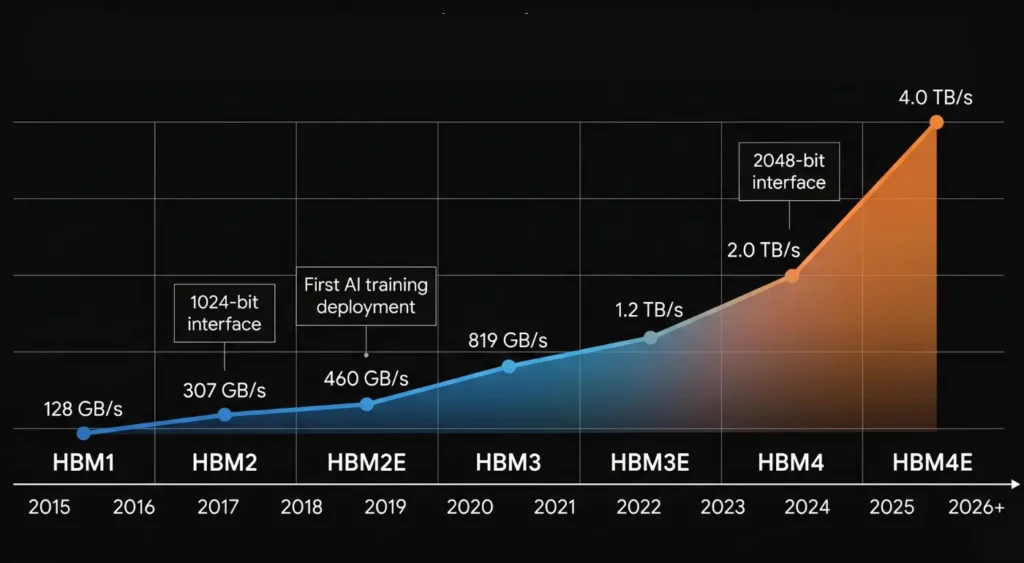
The product lines reflect this split. NVIDIA’s datacenter GPUs use exclusively HBM; its consumer and workstation lines use GDDR7. The same organization buying HBM-based accelerators for training will deploy GDDR7-based workstations for local development. The two technologies are not converging — they are occupying increasingly distinct architectural and economic niches.
Why AI Systems Are Hitting a Memory Bandwidth Wall
Large language models (LLMs) and modern deep learning systems are defined by scale. Today’s leading models contain hundreds of billions of parameters — the numerical values that encode learned knowledge. During both training and inference, GPUs must continuously load these parameters, creating a data movement problem that grows with model size.
A GPU’s compute cores can only work with data in their immediate vicinity. If memory cannot supply data fast enough, processing stalls. Modern GPUs perform trillions of operations per second, but those capabilities are only realized when data flows continuously. When memory bandwidth cannot keep pace, compute capacity sits underutilized. Increasing processing power alone does not yield proportional gains. This phenomenon — where memory bandwidth, not compute throughput, limits overall performance— is what engineers refer to as being memory-bound.
Whether a workload hits this wall depends on its arithmetic intensity: the ratio of operations to data moved. As illustrated by the roofline performance model illustrates, every GPU has a “ridge point” that separates compute-bound workloads from bandwidth-bound ones. Generating a single token in a 70-billion-parameter model requires loading roughly 140 gigabytes of weights (at two bytes per parameter in standard FP16 precision) for only 140 billion operations — an intensity of approximately one FLOP per byte. On an NVIDIA H100 with 3.35 TB/s of memory bandwidth, this arithmetic intensity falls far below the ridge point, the boundary where memory bandwidth rather than compute capacity becomes the limiting factor.
This bandwidth constraint became acute with the scaling of transformer models in the late 2010s and was fully exposed by hundred-billion-parameter models around 2020. General-purpose memory — whether DDR for servers or GDDR for graphics — offers relatively narrow data pathways and is physically separated from the processor by PCB traces. As AI bandwidth requirements have grown, these conventional architectures have become structural bottlenecks.
This constraint is not merely an engineering inconvenience — it reshapes industry structure. When memory bandwidth rather than transistor count limits performance, value accrues to whoever controls advanced packaging and HBM supply. That supply, as we will see, is concentrated among just three companies.
It also creates economic pressure to compress models through quantization and distillation, not because smaller models are inherently superior, but because they require less bandwidth to deploy at scale. Addressing the bandwidth wall requires rethinking how memory is integrated with compute — which is precisely what HBM’s architecture was designed to do.
How HBM Solves the AI Data Bottleneck
High Bandwidth Memory addresses this problem through a fundamental change in how memory is built and positioned. Rather than laying memory chips flat on a circuit board at a distance from the processor, HBM stacks multiple memory layers vertically, connected by through-silicon vias (TSVs) into a single compact unit. This stack sits on a silicon interposer which is a thin piece of silicon that routes signals between the memory stack and the GPU, effectively acting as a microscopic circuit board. The interposer places memory and processor side by side, reducing signal path length by roughly two orders of magnitude.
The architecture also dramatically widens the data pathway. HBM3’s 1024-bit interface is sixteen times wider than a DDR5 channel — 1024 bits (HBM3)/64 bits (DDR5 channel) = 16 —, allowing far more data to flow in parallel. The combination of proximity and width produces memory bandwidth figures that conventional designs cannot approach — from 3.35 TB/s on an NVIDIA H100 to projected 8–13 TB/s on next-generation HBM4-based accelerators.
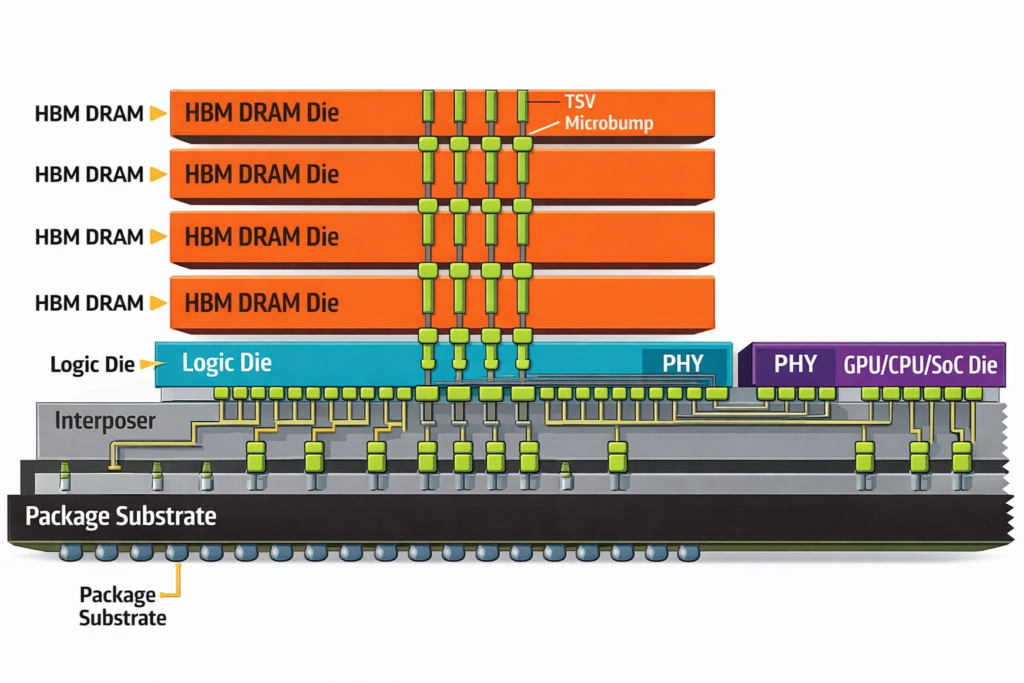
For AI workloads, this matters enormously. A GPU equipped with HBM can feed its compute cores more continuously than with DDR or GDDR-based designs, though for many inference workloads the bottleneck persists and must be managed through batching or model compression. The shift changes how performance improvements are achieved: system design increasingly prioritizes balancing compute with memory throughput. Memory is no longer a supporting component but a co-equal factor in determining overall system performance.
This is why the dominant AI accelerators — NVIDIA’s Hopper and Blackwell architectures, AMD’s Instinct series — rely on HBM as a prerequisite for viable performance. Niche alternatives exist: Groq’s tensor streaming processor uses on-chip SRAM rather than external memory, and Cerebras’s wafer-scale engine distributes memory across the compute fabric itself. These approaches sacrifice generality for bandwidth but remain exceptions in a market shaped by HBM economics.
HBM also reshapes industry structure. It represents a significant portion of a high-end GPU’s bill of materials, and its availability directly constrains shipment volumes. When advanced packaging capacity is tight, silicon yield becomes irrelevant — the GPU cannot ship without memory attached.
However, solving the technical problem introduces a different constraint: HBM can only be manufactured by three companies, using packaging technologies that are themselves capacity-limited. The bottleneck shifts from memory bandwidth to memory supply — and that supply, as the next section examines, is far more concentrated than the AI industry it enables.
Why HBM Supply Is Controlled by Just Three Companies
Despite its central importance to AI hardware, High Bandwidth Memory production is dominated by three companies: SK Hynix, Samsung Electronics, and Micron Technology. As of 2025–2026, SK Hynix holds roughly half of HBM supply, Samsung approximately 40%, and Micron the remainder. This concentration is not accidental. It is a direct result of how difficult HBM is to manufacture and how few companies possess both the DRAM fabrication and advanced packaging capabilities required.
Building HBM requires combining leading-edge memory fabrication with precise 2.5/3D integration. Memory dies are stacked vertically and connected by through-silicon vias (TSVs), then bonded to a logic base die on a silicon interposer alongside the GPU. The vertical stacking demands extreme alignment accuracy; defects in any layer can compromise the entire stack. Tolerances are tight, process steps are numerous, and yield is difficult to maintain at high volumes. These capabilities take years and billions of dollars to develop.
The three suppliers are not interchangeable. According to a 2026 EE Times article, SK Hynix has partnered with TSMC to incorporate 12nm logic as the base die for its HBM4 devices, creating a custom memory solution tailored for specific AI workloads. EE Times reports that Samsung manufactures its logic die in-house at 4nm and handles 3D packaging under one roof — making it the only supplier with a turnkey solution from silicon to final assembly.
The same article notes Samsung is advancing hybrid bonding, fusing copper pads directly without traditional micro-bumps to reduce stack height and improve thermal dissipation. Micron, with a smaller market share, has focused on high-volume production of HBM3E and HBM4 and is pursuing aggressive capacity expansion in the United States. Because of these different approaches, supply risk is distributed unevenly: a TSMC capacity crunch affects SK Hynix differently than Samsung, while Samsung’s vertical integration creates different vulnerabilities.
The barriers to entry extend beyond capital to equipment access and geopolitics. HBM requires both leading-edge DRAM fabrication — a capability held by fewer than five companies globally — and advanced 2.5/3D packaging expertise dominated by TSMC, Samsung, and Intel Foundry. Chinese memory manufacturers, despite state investment, remain blocked by US export controls on the EUV lithography and bonding equipment required for HBM production. The result is a market where incumbency compounds: the three producers control not just fabrication but the packaging partnerships and equipment relationships that finalize assembly.
HBM production also diverts capacity from conventional DRAM because the same fabrication lines and cleanroom space produce both. As manufacturers prioritize HBM — where profit margins are substantially higher — conventional DRAM output shrinks even as total wafer starts remain flat. Samsung anticipates that its HBM sales will more than triple in 2026 compared to 2025, and is expanding HBM4 production capacity. According to TrendForce, Samsung plans to increase HBM production capacity by roughly 47% during 2026, targeting approximately 250,000 HBM wafer starts per month by year-end.
The displacement effect is already visible across the memory market. Samsung memory executive Kim Jaejune warned in April 2026 that significant shortages across memory products are expected to continue through at least 2027, with demand fulfillment rates at record lows. Samsung’s global marketing head Wonjin Lee noted earlier in the year that semiconductor supply constraints would affect the industry throughout 2026.
The irony is that even multi-billion dollar investments will not relieve near-term supply. While all three manufacturers have announced major capacity expansions, commissioning timelines for new facilities extend to 2028. SK Hynix’s Indiana advanced packaging plant, critical for HBM assembly, is not expected to reach mass production until the second half of 2028. Based on announced timelines, new supply in meaningful volume may not arrive until 2028 or later.
This creates a structural supply gap: demand for AI memory is accelerating in 2026, but supply expansion lags by two to three years. These constraints do not remain confined to the supply chain — they directly influence the cost and availability of AI hardware. When HBM supply is tight, NVIDIA cannot ship more GPUs regardless of silicon yield. The bottleneck shifts from memory bandwidth to memory supply, and that supply is controlled by just three companies.
How HBM Is Reshaping the Economics of AI Hardware
The economics of AI hardware have shifted as HBM has become central to chip design. According to Epoch AI, in NVIDIA’s Blackwell B200 GPUs, HBM memory and advanced packaging together account for roughly two-thirds of production cost—an estimated $3,800–$4,800 of a $5,700–$7,300 unit—while the compute die itself represents a minority share. This reverses traditional processor economics, where the compute die dominated cost and memory was purchased separately by the system builder. With HBM integrated into the package, memory supply constraints transmit directly into GPU availability and pricing.
This concentration is occurring within a broader surge in AI infrastructure investment. McKinsey projects that AI-capable data centers will require $5.2 trillion in capital expenditures by 2030. Within that spending, memory has become a disproportionate cost driver at the chip level. When HBM supply tightened in 2024, NVIDIA GPU spot prices rose significantly above listed levels, with price movements tracking memory availability more closely than silicon wafer costs. Cloud providers pass through these upstream costs: AI compute instances remain expensive and scarce, with hourly rates for H100 access ranging from $2.69 to nearly $10 depending on provider.
These economics create structural pricing power. Because HBM supply is concentrated among three manufacturers with multi-year capacity lead times, GPU vendors maintain elevated margins even as production scales. The cost of memory becomes a floor on AI infrastructure pricing that cannot be engineered away through silicon efficiency alone.
These cost pressures, in turn, create strategic leverage. The countries and companies that control HBM supply—and the advanced packaging required to integrate it—are positioned to shape the geography of AI development itself.
Why HBM Has Become a Strategic Chokepoint in the AI Industry
Beyond economics, HBM has acquired genuine strategic significance. NVIDIA’s position as the dominant AI accelerator manufacturer depends not only on chip design but on secured memory supply. According to a Financial Times report published in October 2025, SK Hynix had already sold its entire 2026 HBM production capacity to NVIDIA and other key customers, with HBM4 shipments beginning in the fourth quarter of that year.
For NVIDIA’s upcoming Vera Rubin architecture, Samsung has taken the lead on HBM4 supply after passing qualification tests at 10–11 Gb/s data rates, while SK Hynix is expected to provide roughly half of NVIDIA’s total HBM volume across generations in 2026. This pre-booking dynamic means NVIDIA secures capacity before competitors, turning memory access into a competitive moat.
The dependency extends across the industry. Google’s Trillium TPUs use next-generation HBM with 32GB capacity—double the previous generation—but the specific generation (HBM3 or HBM3E) remains unspecified, suggesting a bandwidth position behind NVIDIA’s HBM3E and upcoming HBM4 roadmap. AMD’s MI450 is projected to top out at 432GB of HBM, while Vera Rubin is expected to pack 16 stacks for 576GB. The fundamental requirement—fast, high-volume data movement close to compute—is not specific to any design, but the HBM generation deployed determines which models can be trained or served efficiently.
Governments and technology policymakers have recognized this concentration. The U.S. CHIPS and Science Act directs federal subsidies toward domestic HBM production, supporting Micron’s expansion in Boise and planned packaging capacity in Indiana. More consequentially, U.S. lawmakers have proposed further restrictions on exports of chipmaking equipment to China.
The draft MATCH Act, announced in April 2026, would prevent the sale or servicing of immersion DUV lithography tools—needed for advanced memory production—to leading Chinese chipmakers including SMIC, Hua Hong, Huawei, CXMT, and YMTC, based on a Reuters report. Existing Dutch government rules already block ASML’s most advanced tools from reaching China, but ASML still sells older DUV lines to Chinese manufacturers and to South Korean and Taiwanese companies with operations there.
The proposed U.S. law would prohibit that as well, extending restrictions to equipment that Chinese firms could otherwise use to develop domestic HBM capabilities. South Korea, home to SK Hynix and Samsung, dominates global HBM production and faces strategic pressure from both Washington and Beijing, making memory supply a bargaining chip in technology diplomacy.
Alternatives to HBM exist but address different constraints. CXL-enabled memory pooling allows servers to share high-capacity DRAM across PCIe, but at bandwidths typically between 100 and 500 GB/s—still an order of magnitude below HBM’s terabyte-per-second speeds. CXL-enabled memory pooling complements HBM by expanding capacity for less bandwidth-intensive workloads, not by replacing HBM for training. On-chip SRAM approaches eliminate external memory entirely but sacrifice model size flexibility. Emerging technologies like optical I/O remain years from production viability. This substitution gap means HBM’s chokepoint position is likely to persist through the current decade.
The result is a structural shift in how AI systems are constrained. AI hardware performance is no longer determined primarily by chip design or software optimization. It is determined by who can secure HBM supply—and at what political and economic cost. The AI industry, in both the technical and strategic meanings, has become a memory-bound industry.
Why Memory Bandwidth Is Moving to the Center of the AI Industry
HBM has moved from a specialized component to a defining constraint in the AI industry. Its bandwidth enables the largest models; its manufacturing complexity limits how many chips can be produced; and its concentration among three companies gives those producers — and the countries where they operate — structural leverage over the pace of AI deployment.
This is not a temporary bottleneck. As models grow and inference demand expands, memory bandwidth requirements will outpace even HBM4’s generational improvements. The industry is already responding with model compression, speculative decoding, and custom silicon — all workarounds for a memory wall that HBM alone cannot remove. The longer-term question is whether new architectures — optical interconnects, processing-in-memory, or fundamentally different compute paradigms — can eventually bypass the bandwidth constraint, or whether HBM’s chokepoint position will harden into a permanent feature of AI’s industrial structure.
For now, understanding AI requires understanding memory. The companies and countries that control HBM supply are not merely component vendors. They are gatekeepers to the next phase of artificial intelligence.
This article is being provided for educational purposes only. The information contained in this article does not constitute a recommendation from Intellaix to the recipient, and Intellaix is not providing any financial, economic, legal, investment, accounting, or tax advice through this article or to its recipient.
Sources and references:
- Bloomberg, January 2025. “High-Bandwidth Memory Chip Market Could Grow to $130 Billion by 2033, According to Bloomberg Intelligence”
- ScienceDirect. “Through-silicon via advanced packaging technology and its radio frequency applications”
- ScienceDirect. “Silicon Interposers”
- Rambus March 2026. “High Bandwidth Memory (HBM): Everything You Need to Know”
- Nvidia. “NVIDIA H100 GPU”
- JEDEC. “High Bandwidth Memory (HBM4) DRAM – (JESD270-4A)
- Samsung, March 2026. “Samsung Unveils HBM4E, Showcasing Comprehensive AI Solutions, NVIDIA Partnership and Vision at NVIDIA GTC 2026”
- Micron, March 2026. “Micron in High-Volume Production of HBM4 Designed for NVIDIA Vera Rubin, PCIe Gen6 SSD and SOCAMM2”
- JEDEC, May 2026. “Graphics Double Data Rate 7 SGRAM Standard (GDDR7) – JESD239E”
- Epoch AI, November 2024. “Data movement bottlenecks to large-scale model training: Scaling past 1e28 FLOP”
- ScienceDirect. “Memory Bound”
- NERSC. “Roofline Performance Model”
- Nvidia, October 2025. “Unlock Faster, Smarter Edge Models with 7x Gen AI Performance on NVIDIA Jetson AGX Thor”
- Semianalysis, September 2024. “The Memory Wall: Past, Present, and Future of DRAM”
- Groq, March 2025. “What is a Language Processing Unit?
- Cerebras, May 2024. “Cerebras Wafer Scale Engine Outperforms World’s #1 Supercomputer, Achieving Long-Timescale Molecular Dynamics Simulations 179x Faster”
- Conterpoint, March 2026. “Global DRAM and HBM Market Share: Quarterly”
- EE Times, January 2026. “The State of HBM4 Chronicled at CES 2026”
- Congress.gov, September 2025. “U.S. Export Controls and China: Advanced Semiconductors”
- Samsung, February 2026. “Samsung Ships Industry-First Commercial HBM4 With Ultimate Performance for AI Computing”
- TendForce, December 2025. “Samsung Reportedly Plans 50% HBM Capacity Surge in 2026, Spotlight on HBM4”
- Reuters, January 2026. “Samsung sees acute chip shortage persisting, warns of mobiles headwind after profit triples”
- Yahoo, January 2026. “Samsung Warns Memory Shortages Could Push Electronics Prices Higher”
- TrendForce, April 2026. “SK hynix Reportedly Breaks Ground on First U.S. Advanced Packaging Plant in Indiana, Eyes 2H28 Production”
- Epoch AI, December 2025. “NVIDIA’s B200 costs around $6,400 to produce, with memory accounting for half”
- McKinsey & Company, April 2025. “The cost of compute: A $7 trillion race to scale data centers”
- Jarvis Labs, March 2026. “NVIDIA H100 Price Guide 2026: GPU Costs, Cloud Pricing & Buy vs Rent”
- Financial Times, October 2025. “Nvidia supplier SK Hynix has already sold next year’s chips on AI boom”
- TrendForce, March 2026. “Samsung, SK hynix Reportedly Tapped as NVIDIA Rubin HBM4 Suppliers; Shipments Could Start in March”
- HPCwire, May 2024. “Google Announces Sixth-generation AI Chip, a TPU Called Trillium”
- Reuters, April 2026. “US targets Chinese chipmaking with proposed export restrictions on ASML and others”
